
February 2026 Market Report

Photo by Brett Wharton on Unsplash
While national home price appreciation is stuttering to a halt and many states and regions are seeing price declines, San Francisco's median home sales prices continue to surge higher, a dynamic we expect to see continue in 2026. The underlying factors are an extremely inadequate supply of homes for sale vs. rapidly increasing demand due to the AI startup boom. Very fast sales and competitive bidding wars between buyers have become the norm. Though the city’s house market has been seeing the lowest supply and highest demand, its condo market is also experiencing a dramatic rebound. Rents have also been in rapid ascent with the influx of young high-tech workers eager to work in AI.
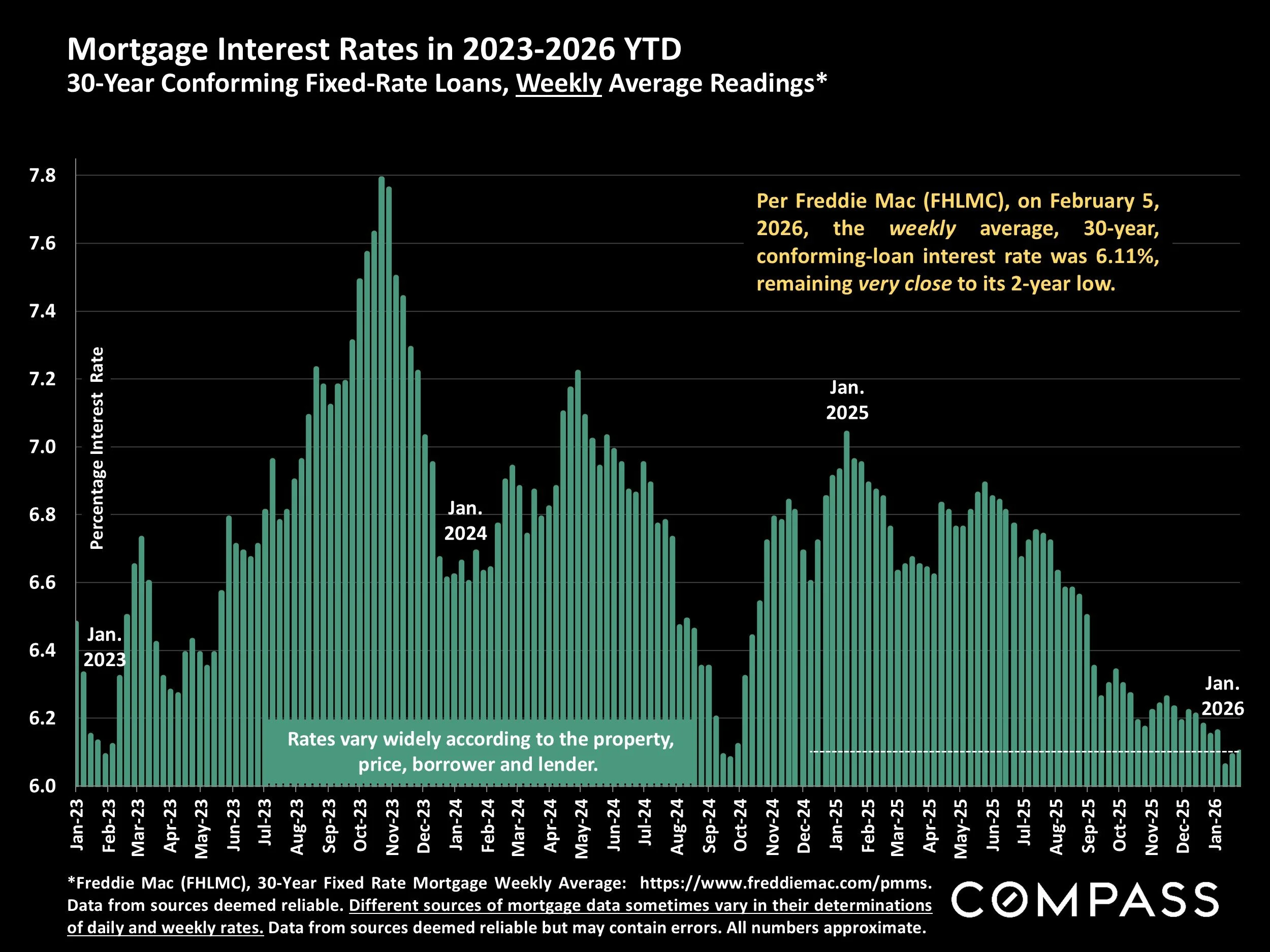
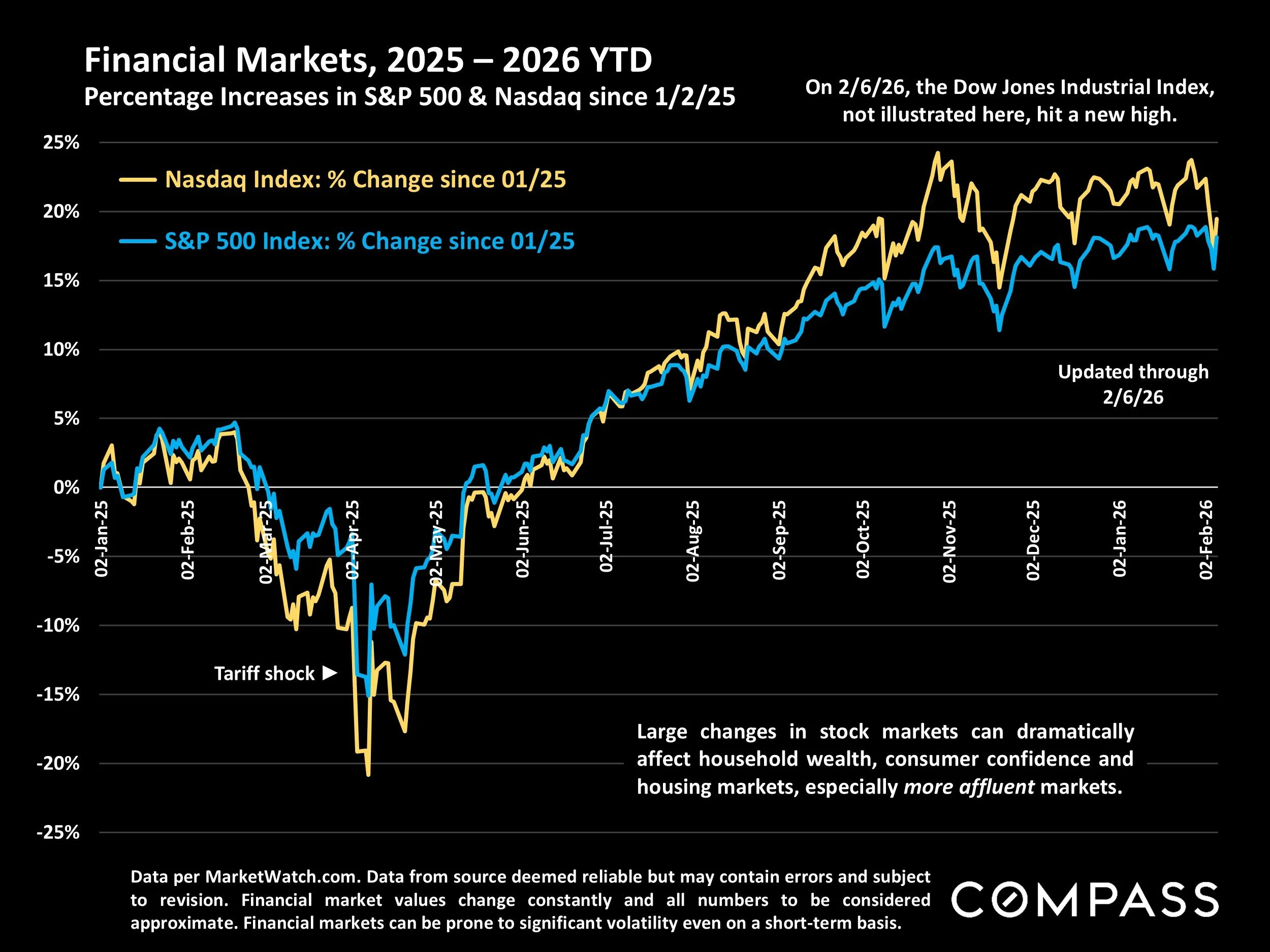
Interest rates are near multi-year lows and stock markets, though recently volatile, remain at or not too far off all-time highs. Local AI startup valuations have been skyrocketing with substantial effect on employee wealth. Though national consumer confidence remains low and employment concerns continue, they don’t appear to be impacting San Francisco. As has been the case in the past 2 years, more affluent buyers seem poised to play an outsized role in demand.
We anticipate a very heated spring market, and in the Bay Area “spring” often starts in February.
Report created in good faith using data from sources deemed reliable but may contain errors and subject to revision. Last period figures are preliminary estimates based on data available early in the following month. All numbers approximate and may change with late-reported activity.
Mortgage Interest Rates in 2023-2026 YTD
30-Year Conforming Fixed-Rate Loans, Weekly Average Readings*
*Freddie Mac (FHLMC), 30-Year Fixed Rate Mortgage Weekly Average: https://www.freddiemac.com/pmms. Data from sources deemed reliable. Different sources of mortgage data sometimes vary in their determinations of daily and weekly rates. Data from sources deemed reliable but may contain errors. All numbers approximate.
Per Freddie Mac (FHLMC), on February 5, 2026, the weekly average, 30-year, conforming-loan interest rate was 6.11%, remaining very close to its 2-year low.
Financial Markets, 2025 – 2026 YTD
Percentage Increases in S&P 500 & Nasdaq since 1/2/25
Data per MarketWatch.com. Data from source deemed reliable but may contain errors and subject to revision. Financial market values change constantly and all numbers to be considered approximate. Financial markets can be prone to significant volatility even on a short-term basis.
On 2/6/26, the Dow Jones Industrial Index, not illustrated here, hit a new high.
Large changes in stock markets can dramatically affect household wealth, consumer confidence and housing markets, especially more affluent markets.
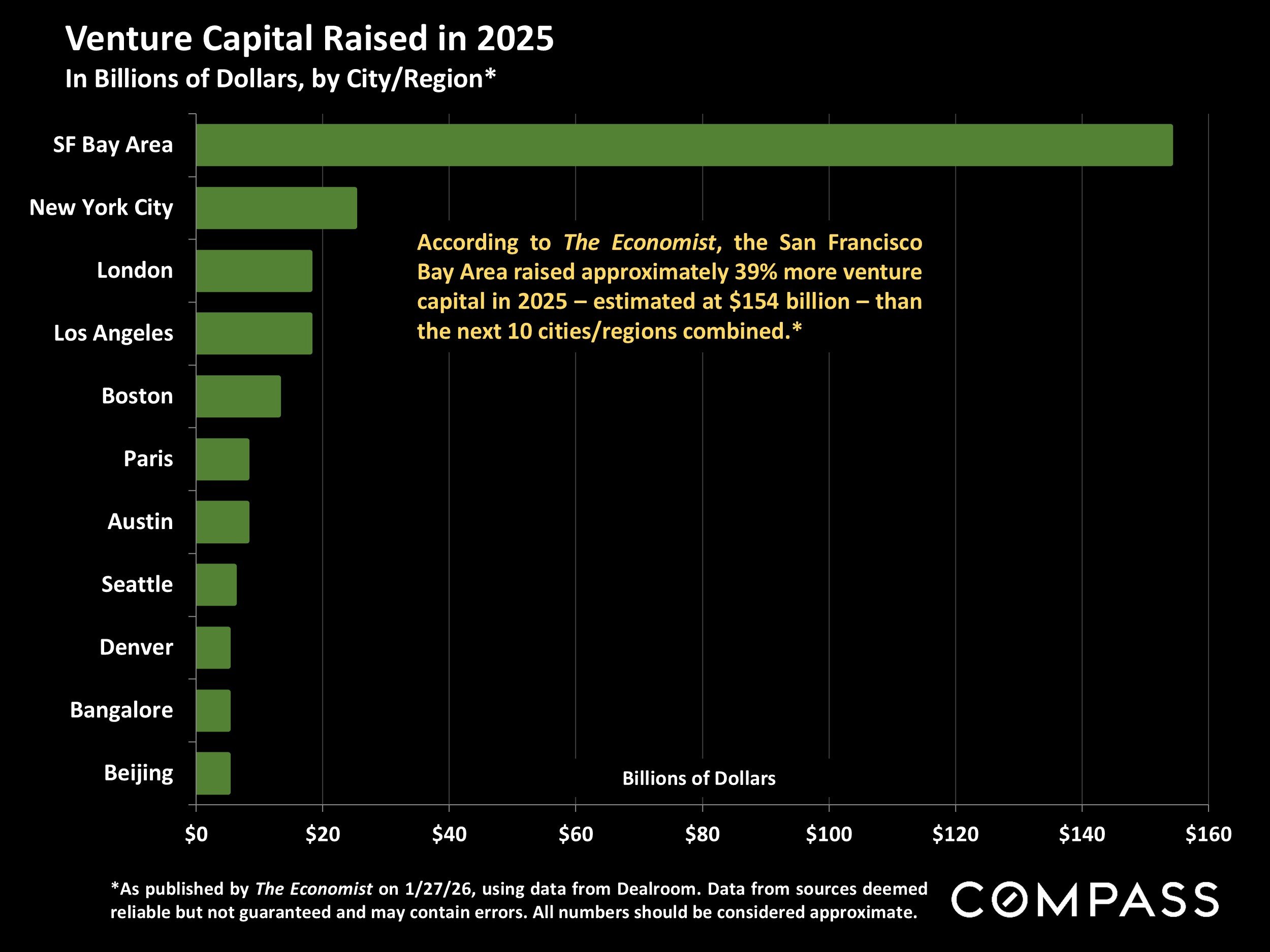
Venture Capital Raised in 2025
In Billions of Dollars, by City/Region*
*As published by The Economist on 1/27/26, using data from Dealroom. Data from sources deemed reliable but not guaranteed and may contain errors. All numbers should be considered approximate.
According to The Economist, the San Francisco Bay Area raised approximately 39% more venture capital in 2025 – estimated at $154 billion – than the next 10 cities/regions combined.*
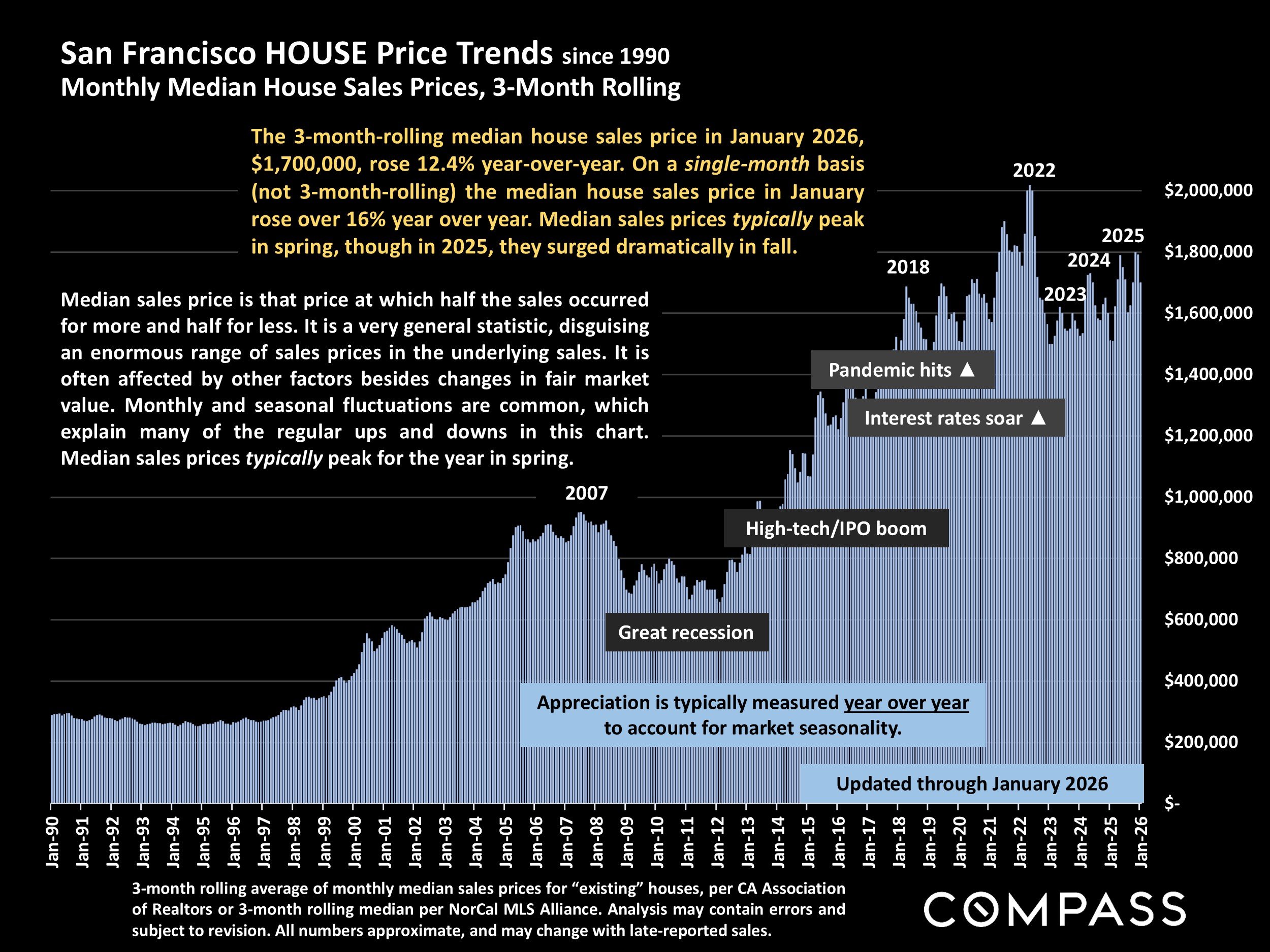
San Francisco HOUSE Price Trends since 1990
Monthly Median House Sales Prices, 3-Month Rolling
3-month rolling average of monthly median sales prices for “existing” houses, per CA Association of Realtors or 3-month rolling median per NorCal MLS Alliance. Analysis may contain errors and subject to revision. All numbers approximate, and may change with late-reported sales.
The 3-month-rolling median house sales price in January 2026, $1,700,000, rose 12.4% year-over-year. On a single-month basis (not 3-month-rolling) the median house sales price in January rose over 16% year over year. Median sales prices typically peak in spring, though in 2025, they surged dramatically in fall.
Median sales price is that price at which half the sales occurred for more and half for less. It is a very general statistic, disguising an enormous range of sales prices in the underlying sales. It is often affected by other factors besides changes in fair market value. Monthly and seasonal fluctuations are common, which explain many of the regular ups and downs in this chart. Median sales prices typically peak for the year in spring.
Median House Sales Price Appreciation
San Francisco % Change in Annual Median Sales Price*
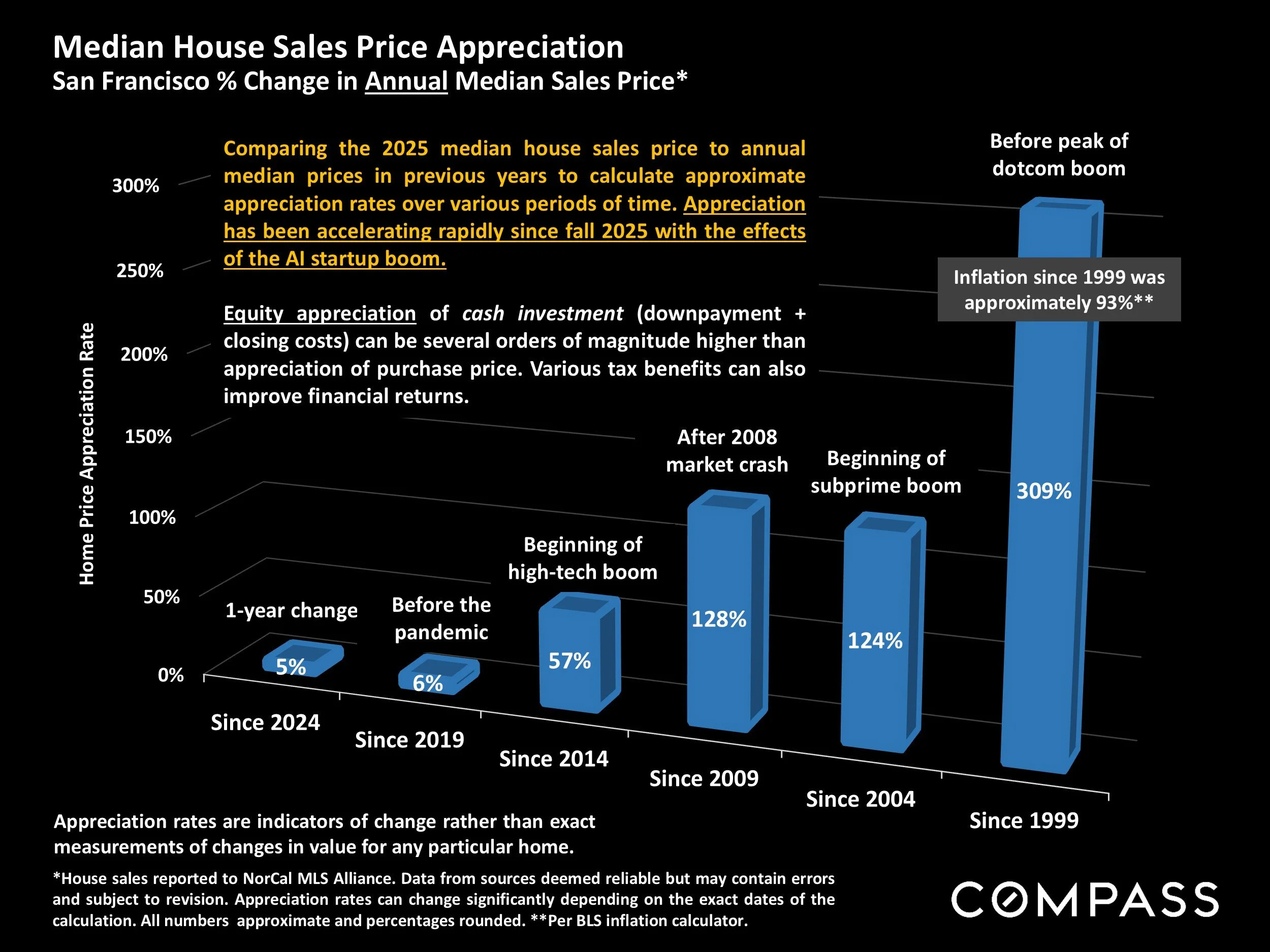
House sales reported to NorCal MLS Alliance. Data from sources deemed reliable but may contain errors and subject to revision. Appreciation rates can change significantly depending on the exact dates of the calculation. All numbers approximate and percentages rounded. *Per BLS inflation calculator.
Comparing the 2025 median house sales price to annual median prices in previous years to calculate approximate appreciation rates over various periods of time. Appreciation has been accelerating rapidly since fall 2025 with the effects of the AI startup boom.
Equity appreciation of cash investment (downpayment + closing costs) can be several orders of magnitude higher than appreciation of purchase price. Various tax benefits can also improve financial returns.
Appreciation rates are indicators of change rather than exact measurements of changes in value for any particular home.
San Francisco CONDO Price Trends since 2005
Median 2-Bedroom Condo Sales Price, 3-Month Rolling
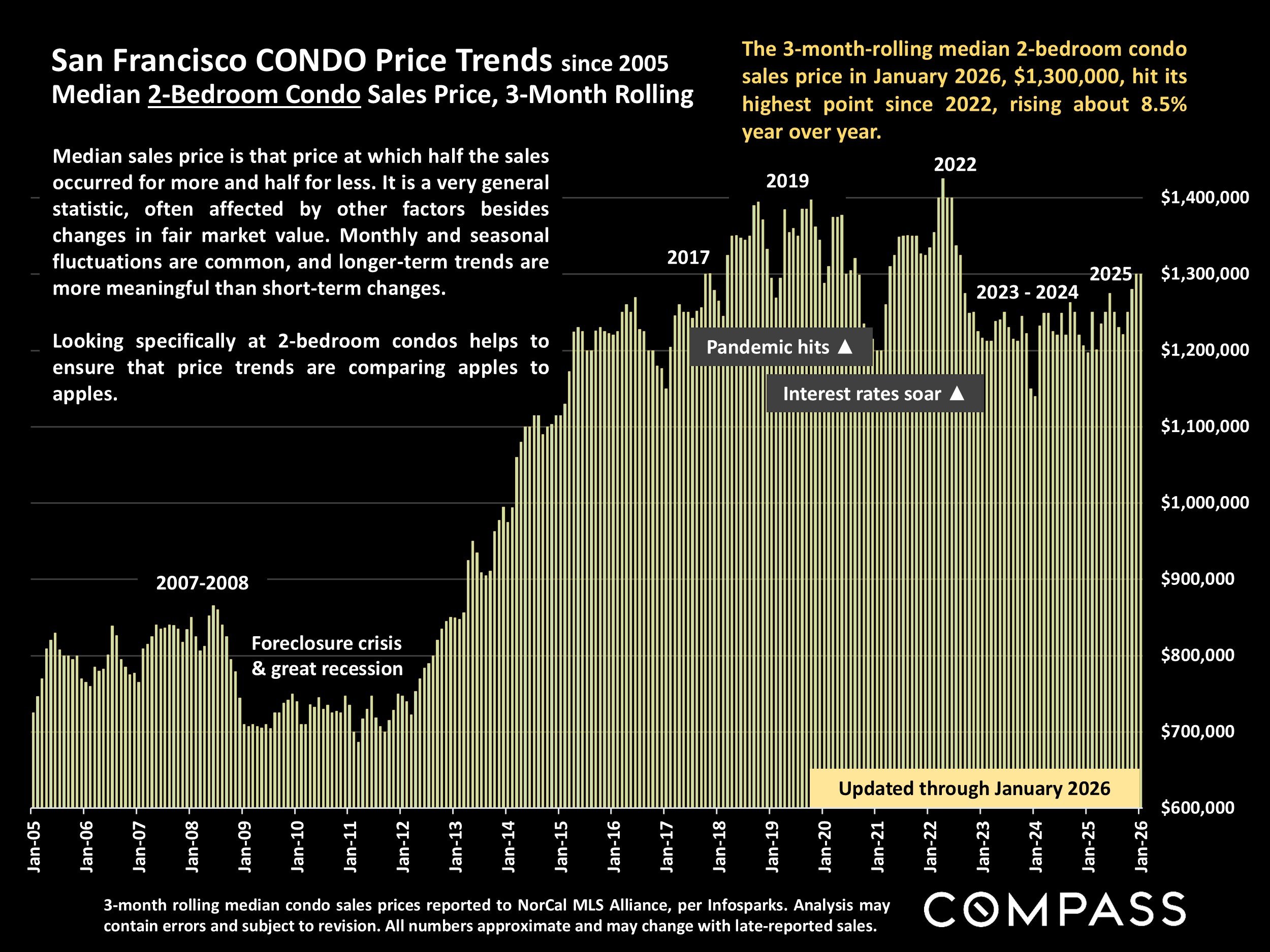
3-month rolling median condo sales prices reported to NorCal MLS Alliance, per Infosparks. Analysis may contain errors and subject to revision. All numbers approximate and may change with late-reported sales.
The 3-month-rolling median 2-bedroom condo sales price in January 2026, $1,300,000, hit its highest point since 2022, rising about 8.5% year over year.
Median sales price is that price at which half the sales occurred for more and half for less. It is a very general statistic, often affected by other factors besides changes in fair market value. Monthly and seasonal fluctuations are common, and longer-term trends are more meaningful than short-term changes.
Looking specifically at 2-bedroom condos helps to ensure that price trends are comparing apples to apples.
Median Condo Sales Price Appreciation
San Francisco % Change in Annual Median Sales Price*
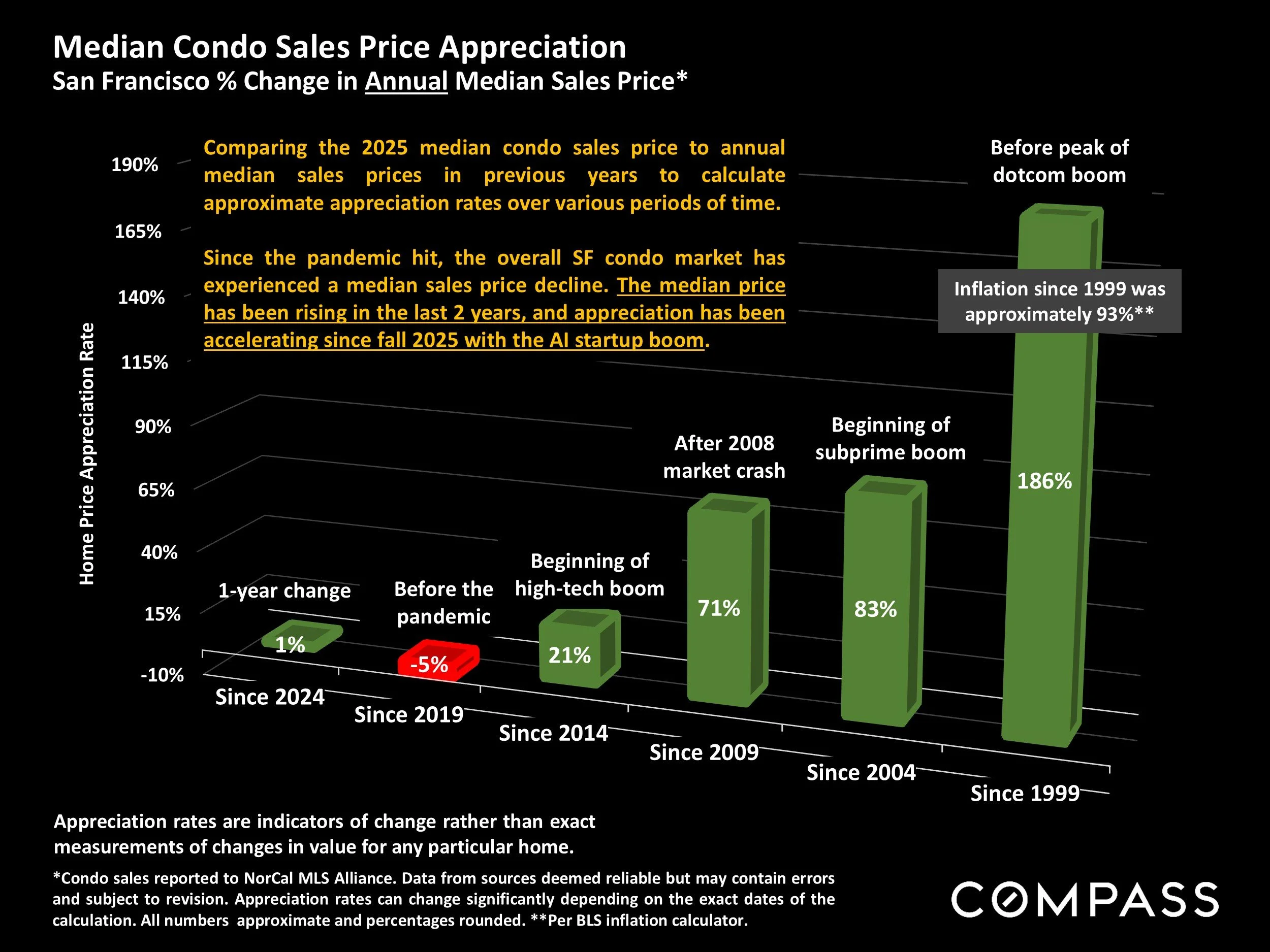
Condo sales reported to NorCal MLS Alliance. Data from sources deemed reliable but may contain errors and subject to revision. Appreciation rates can change significantly depending on the exact dates of the calculation. All numbers approximate and percentages rounded. *Per BLS inflation calculator.
Comparing the 2025 median condo sales price to annual median sales prices in previous years to calculate approximate appreciation rates over various periods of time.
Since the pandemic hit, the overall SF condo market has experienced a median sales price decline. The median price has been rising in the last 2 years, and appreciation has been accelerating since fall 2025 with the AI startup boom.
Appreciation rates are indicators of change rather than exact measurements of changes in value for any particular home.
San Francisco Value Trends since 2005
3-Month-Rolling, Median Dollar per Square Foot Values*
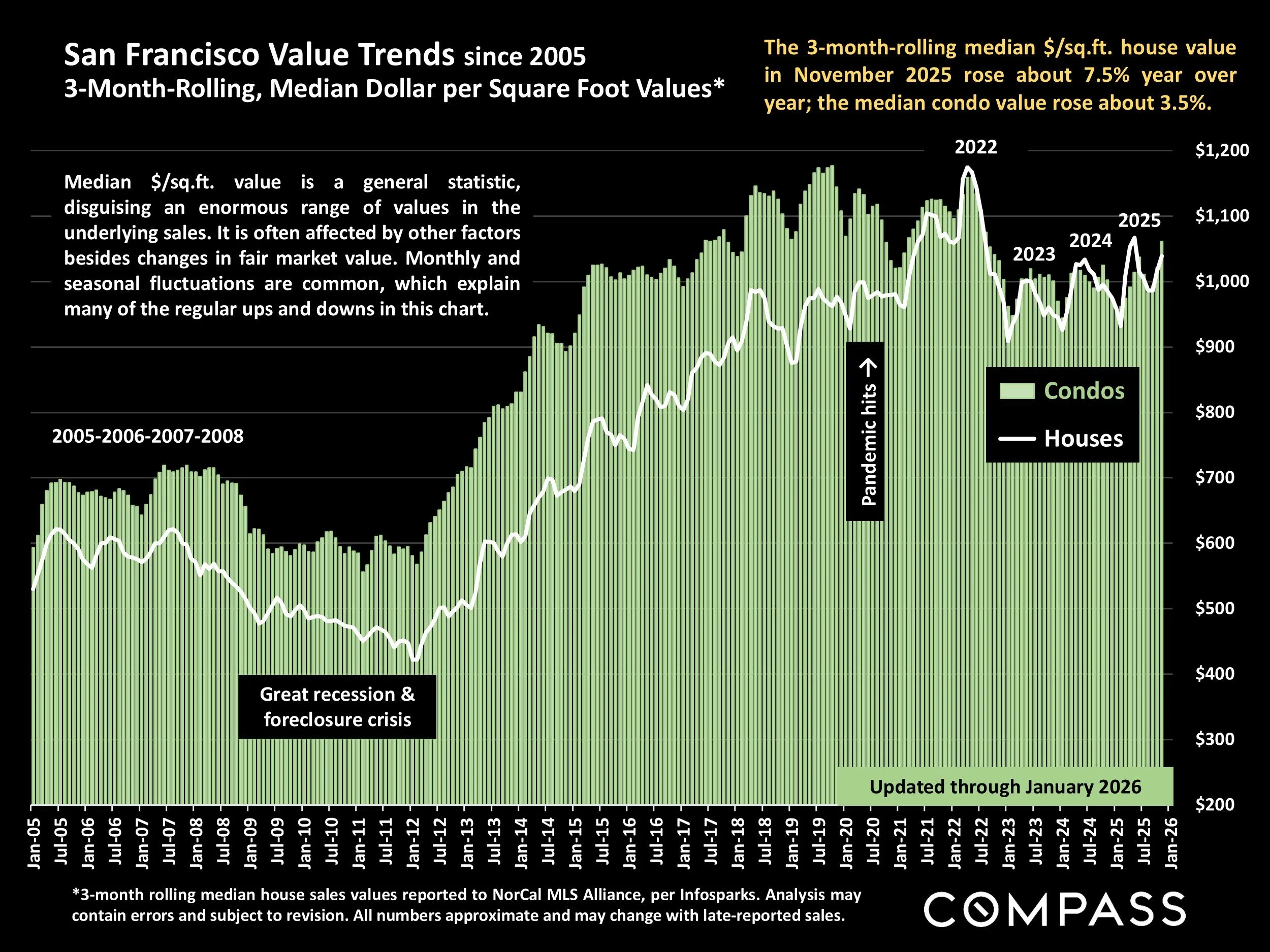
*3-month rolling median house sales values reported to NorCal MLS Alliance, per Infosparks. Analysis may contain errors and subject to revision. All numbers approximate and may change with late-reported sales.
The 3-month-rolling median $/sq.ft. house value in November 2025 rose about 7.5% year over year; the median condo value rose about 3.5%.
Median $/sq.ft. value is a general statistic, disguising an enormous range of values in the underlying sales. It is often affected by other factors besides changes in fair market value. Monthly and seasonal fluctuations are common, which explain many of the regular ups and downs in this chart.
San Francisco CONDO Prices: Downtown vs. Non-Downtown
12-Month-Rolling, Median 2-Bedroom Condo Sales Prices since 2005*
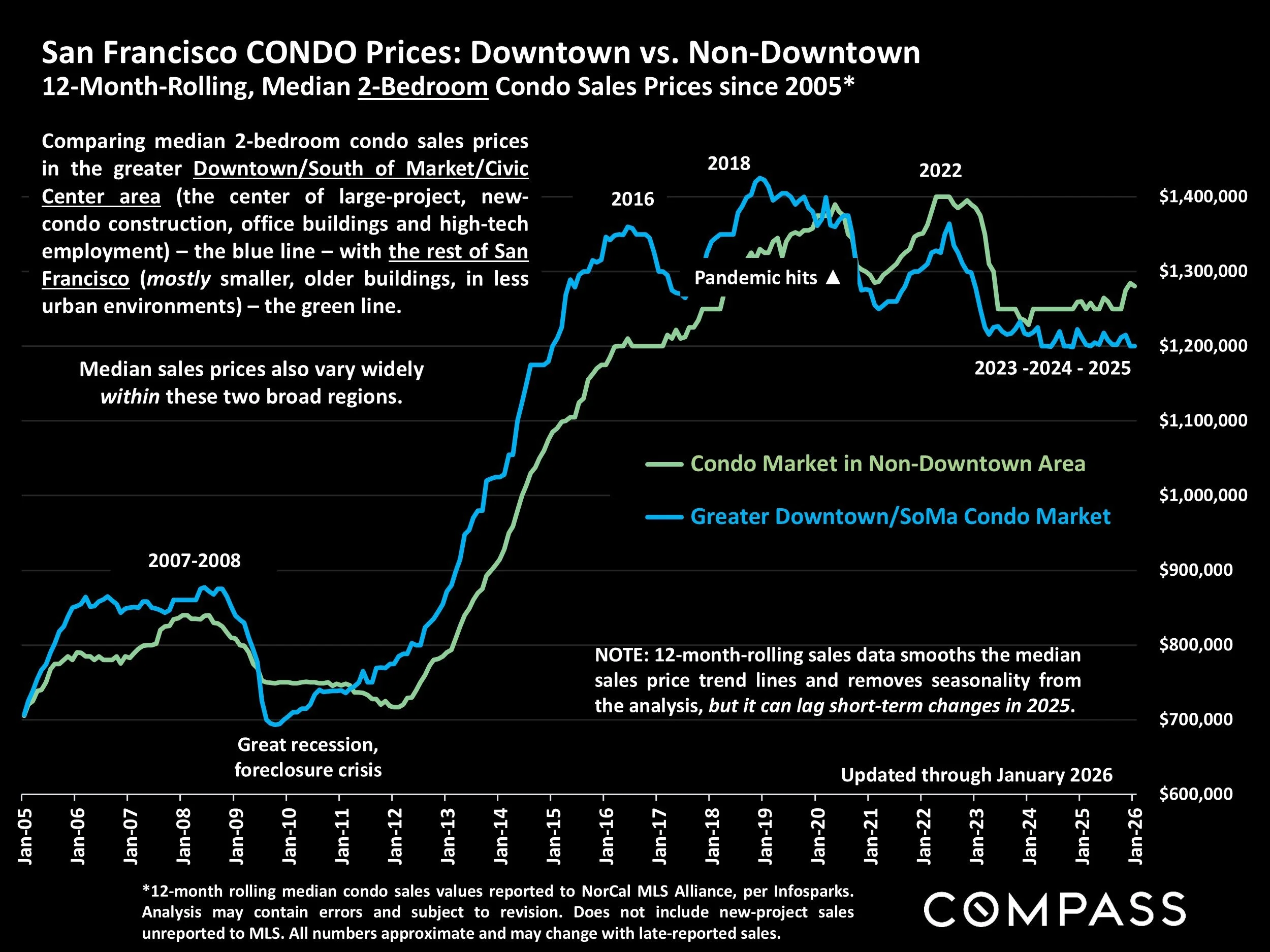
*12-month rolling median condo sales values reported to NorCal MLS Alliance, per Infosparks. Analysis may contain errors and subject to revision. Does not include new-project sales unreported to MLS. All numbers approximate and may change with late-reported sales.
Comparing median 2-bedroom condo sales prices in the greater Downtown/South of Market/Civic Center area (the center of large-project, new-condo construction, office buildings and high-tech employment) – the blue line – with the rest of San Francisco (mostly smaller, older buildings, in less urban environments) – the green line.
Median sales prices also vary widely within these two broad regions.
New Listings Coming on Market
San Francisco Market Dynamics & Seasonality*
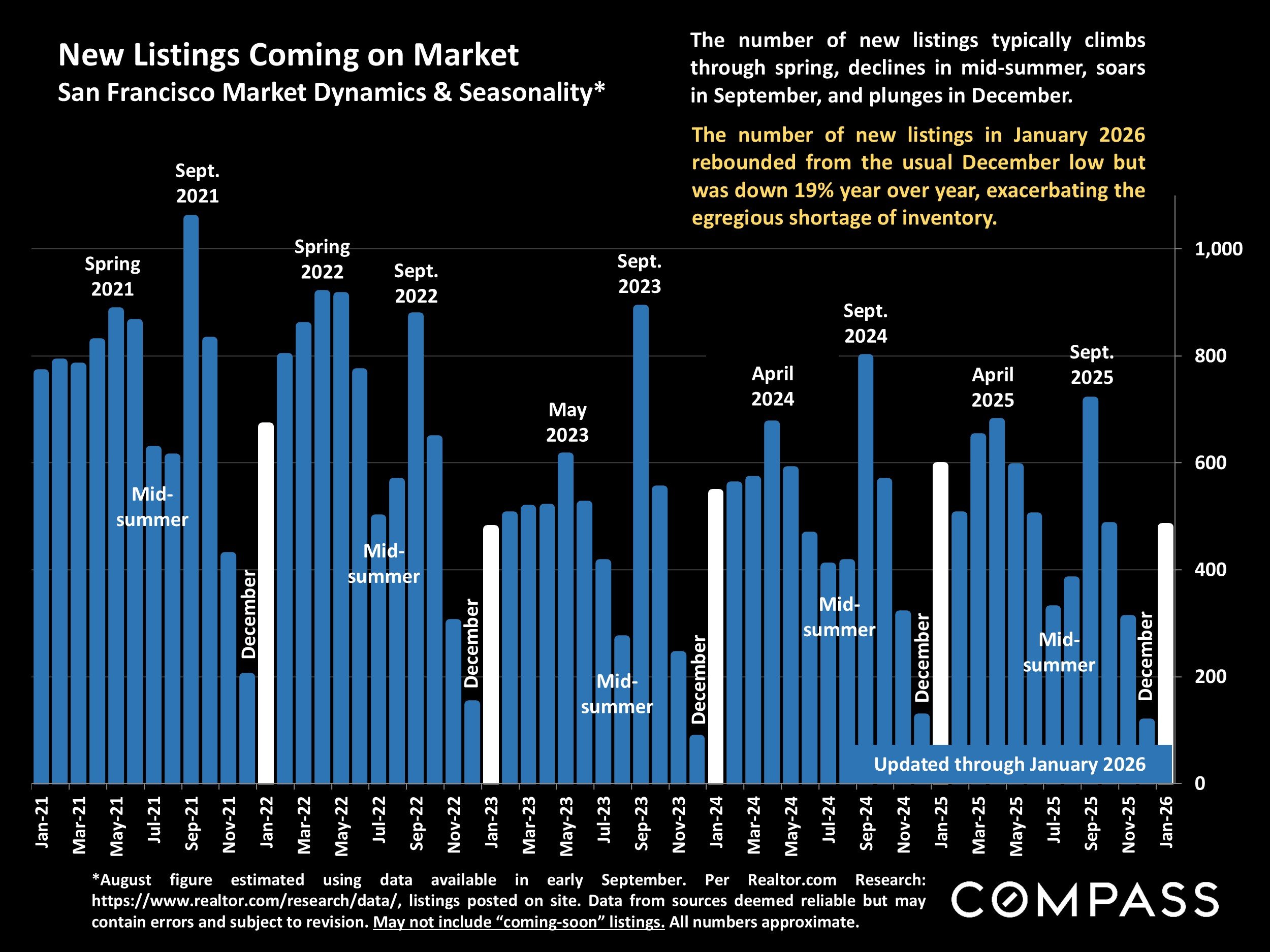
*August figure estimated using data available in early September. Per Realtor.com Research: https://www.realtor.com/research/data/, listings posted on site. Data from sources deemed reliable but may contain errors and subject to revision. May not include “coming-soon” listings. All numbers approximate.
The number of new listings in January 2026 rebounded from the usual December low but was down 19% year over year, exacerbating the egregious shortage of inventory.
The number of new listings typically climbs through spring, declines in mid-summer, soars in September, and plunges in December.
Active & Coming-Soon Listings on 1st of Month*
San Francisco Homes Market
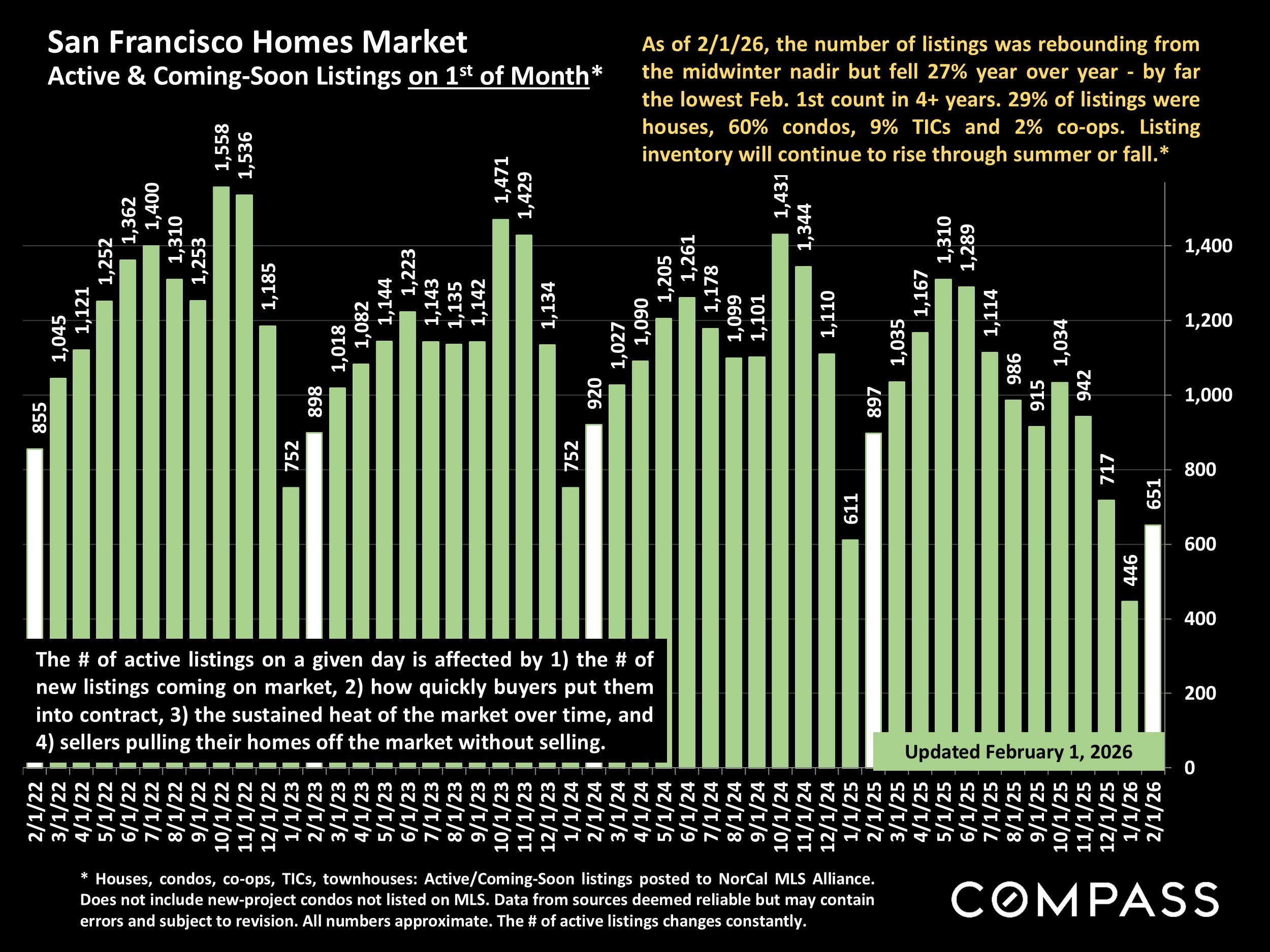
* Houses, condos, co-ops, TICs, townhouses: Active/Coming-Soon listings posted to NorCal MLS Alliance. Does not include new-project condos not listed on MLS. Data from sources deemed reliable but may contain errors and subject to revision. All numbers approximate. The # of active listings changes constantly.
As of 2/1/26, the number of listings was rebounding from the midwinter nadir but fell 27% year over year - by far the lowest Feb. 1st count in 4+ years. 29% of listings were houses, 60% condos, 9% TICs and 2% co-ops. Listing inventory will continue to rise through summer or fall.*
The # of active listings on a given day is affected by 1) the # of new listings coming on market, 2) how quickly buyers put them into contract, 3) the sustained heat of the market over time, and 4) sellers pulling their homes off the market without selling.
Number of HOUSES for Sale
by Bay Area County, as of 2/1/26*
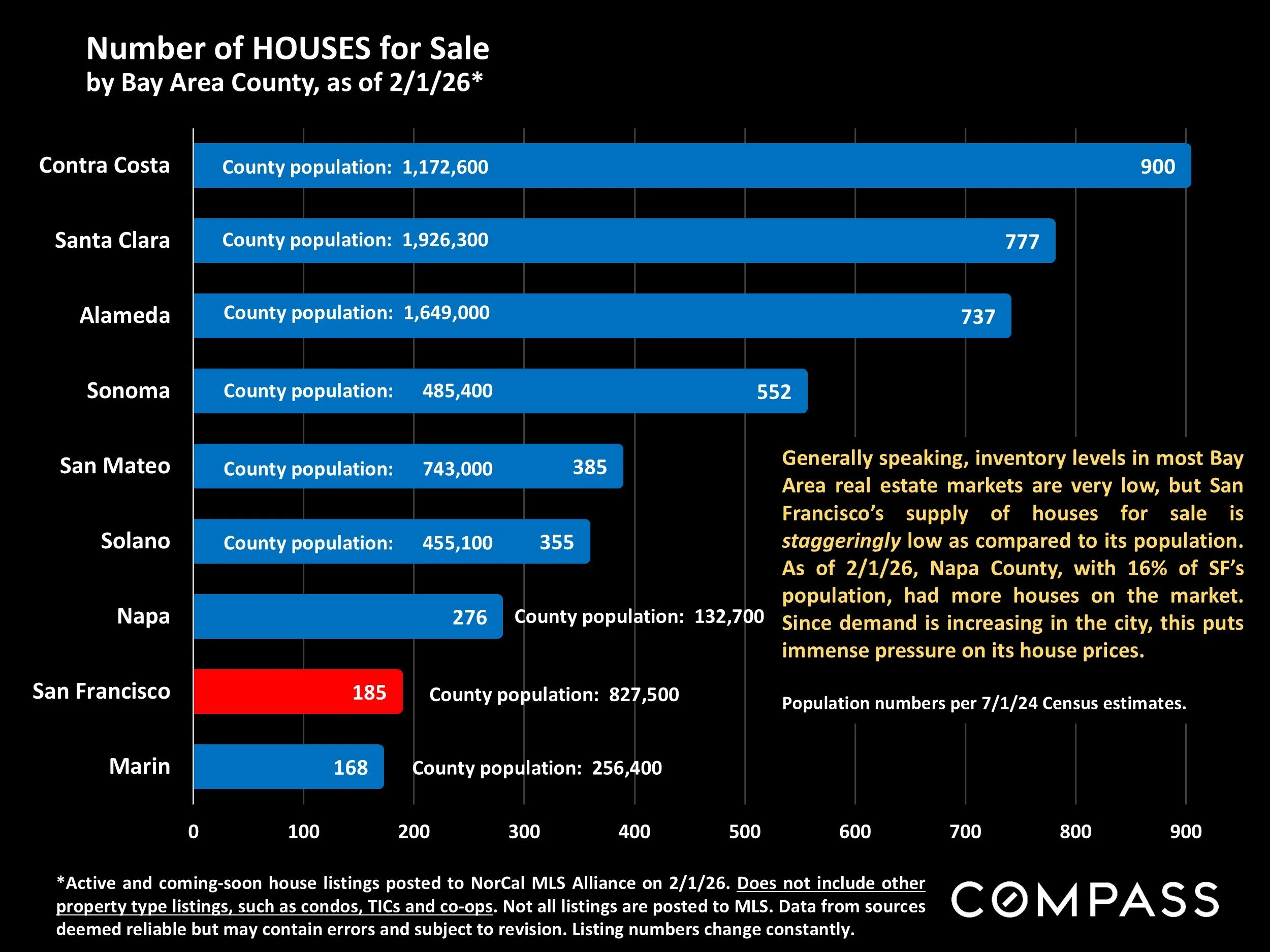
*Active and coming-soon house listings posted to NorCal MLS Alliance on 2/1/26. Does not include other property type listings, such as condos, TICs and co-ops. Not all listings are posted to MLS. Data from sources deemed reliable but may contain errors and subject to revision. Listing numbers change constantly.
Generally speaking, inventory levels in most Bay Area real estate markets are very low, but San Francisco’s supply of houses for sale is staggeringly low as compared to its population. As of 2/1/26, Napa County, with 16% of SF’s population, had more houses on the market. Since demand is increasing in the city, this puts immense pressure on its house prices.
Population numbers per 7/1/24 Census estimates.
Market Dynamics by Price Segment/Property Type
San Francisco Residential Market
| Price/ Prop. Type | # Listings for Sale* | # Listings in Contract* | Monthly Rate of Sales** | Supply of Inventory*** | Avg. Days on Market** | Sales Over List Price** | Avg. Sales Price to LP %** |
|---|---|---|---|---|---|---|---|
| Under $1,000,000 | 284 | 95 | 116 sales/mo. | 2.4 months | 66 days | 31% | 97.5% |
| $1,000,000 - $1,999,999 | 225 | 98 | 196 sales/mo. | 1.1 months | 34 days | 64% | 109% |
| $2,000,000 - $2,999,999 | 67 | 24 | 63 sales/mo. | 1.1 months | 26 days | 73% | 111% |
| $3,000,000 - $4,999,999 | 42 | 8 | 32 sales/mo. | 1.3 months | 34 days | 59% | 106% |
| $5,000,000 - $7,499,999 | 16 | 2 | 6 sales/mo. | 2.7 months | 45 days | 33% | 98.5% |
| $7,500,000 - $9,999,999 | 6 | 2 | 4 sales/mo. | 1.5 months | 52 days | 20% | 97% |
| $10 Million+ | 12 | 0 | 2 sales/mo. | 6 months | too few sales | 4% | 88.5% |
| Houses | 185 | 91 | 192 sales/mo. | 1 month | 27 days | 75% | 112.5% |
| Condos | 389 | 113 | 189 sales/mo. | 2.1 months | 56 days | 36% | 100% |
| TICs | 59 | 20 | 27 sales/mo. | 2.2 months | 54 days | 46% | 100.5% |
| Co-ops | 13 | 7 | 5.5 sales/mo. | 2.4 months | 71 days | 16% | 97.5% |
Listings Accepting Offers (Going into Contract)
San Francisco Market Dynamics & Seasonality
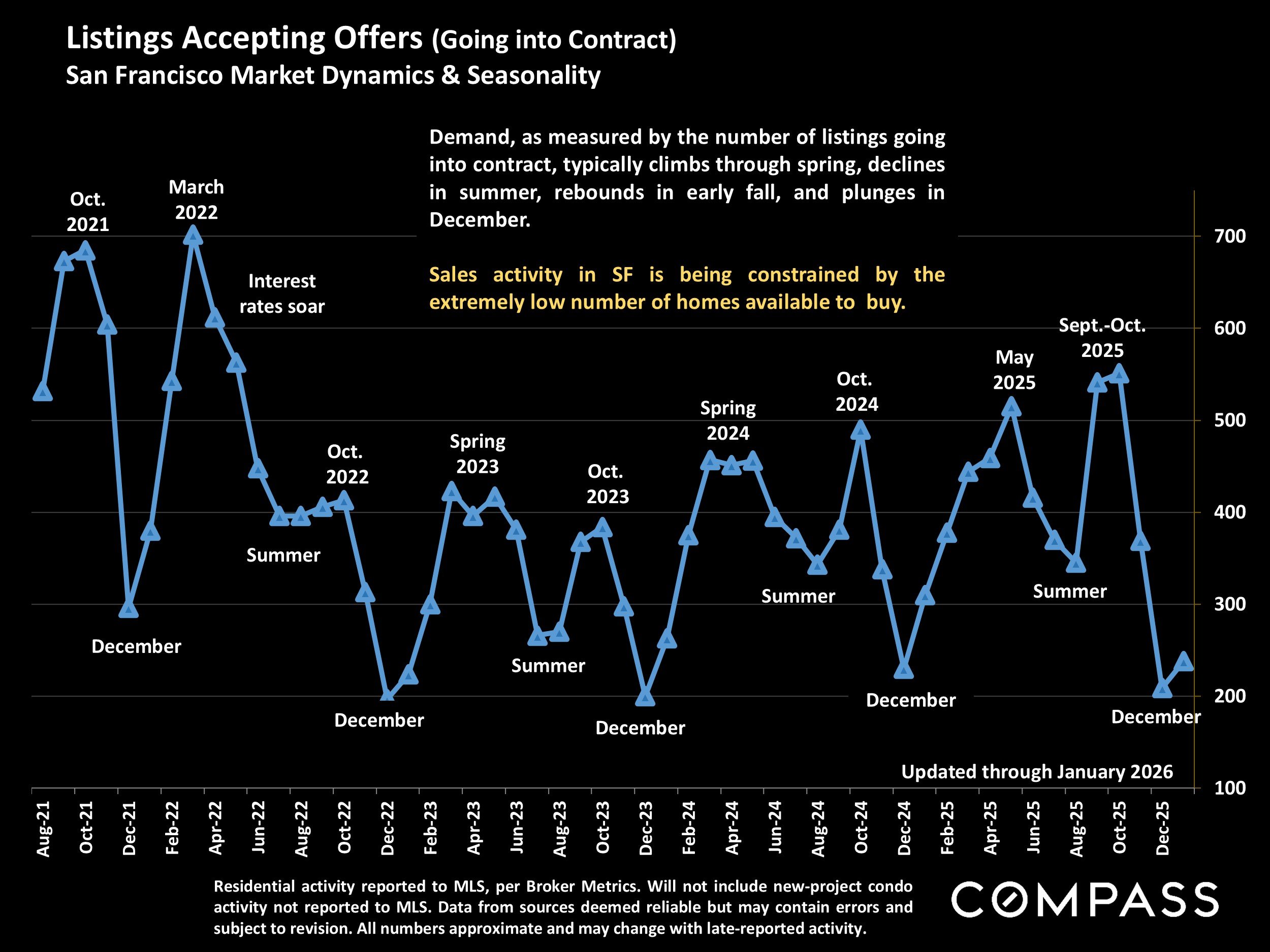
Residential activity reported to MLS, per Broker Metrics. Will not include new-project condo activity not reported to MLS. Data from sources deemed reliable but may contain errors and subject to revision. All numbers approximate and may change with late-reported activity.
Sales activity in SF is being constrained by the extremely low number of homes available to buy.
Demand, as measured by the number of listings going into contract, typically climbs through spring, declines in summer, rebounds in early fall, and plunges in December.
Percentage of Listings Accepting Offers
San Francisco: Absorption Rate by Month

*SFARMLS reported data, per Broker Metrics. Not all new-condo project activity is reported to MLS. Last month’s data estimated using available data and may change with late reported activity. Data from sources deemed reliable but may contain errors and subject to revision. All numbers approximate.
The SF market shifted dramatically in fall 2025. The absorption rate in January 2026 was 45% higher than in January 2025.
Absorption rate measures buyer demand vs. the supply of listings for sale: The higher the percentage, the more heated and competitive the market.
Monthly Home Sales Volume*
San Francisco Market Dynamics & Seasonality
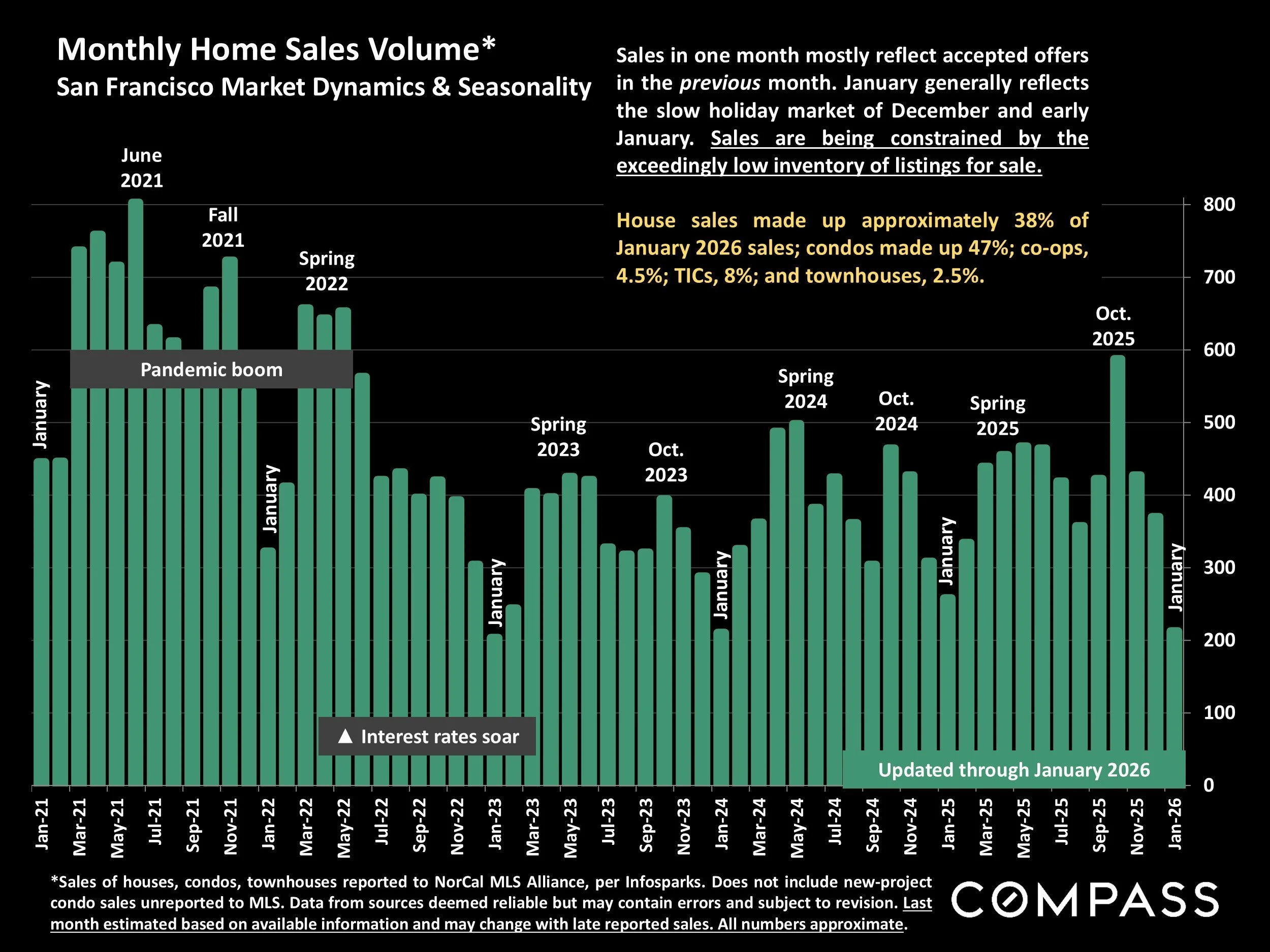
*Sales of houses, condos, townhouses reported to NorCal MLS Alliance, per Infosparks. Does not include new-project condo sales unreported to MLS. Data from sources deemed reliable but may contain errors and subject to revision. Last month estimated based on available information and may change with late reported sales. All numbers approximate.
House sales made up approximately 38% of January 2026 sales; condos made up 47%; co-ops, 4.5%; TICs, 8%; and townhouses, 2.5%.
Sales in one month mostly reflect accepted offers in the previous month. January generally reflects the slow holiday market of December and early January. Sales are being constrained by the exceedingly low inventory of listings for sale.
San Francisco Luxury Home Sales
Sales Prices of $5,000,000+
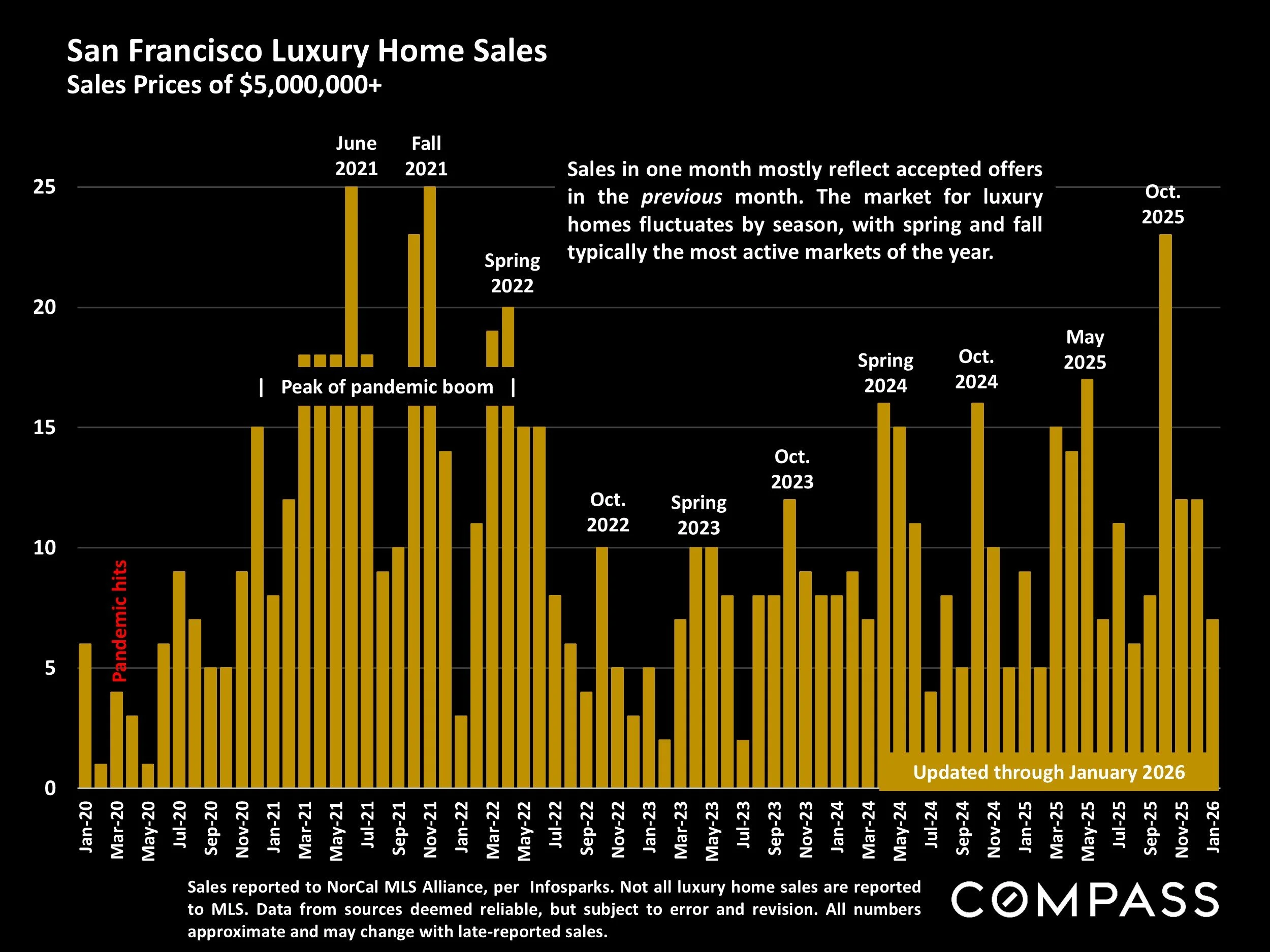
Sales reported to NorCal MLS Alliance, per Infosparks. Not all luxury home sales are reported to MLS. Data from sources deemed reliable, but subject to error and revision. All numbers approximate and may change with late-reported sales.
Sales in one month mostly reflect accepted offers in the previous month. The market for luxury homes fluctuates by season, with spring and fall typically the most active markets of the year.
Price Reductions on Active Listings
San Francisco Market Dynamics & Seasonality
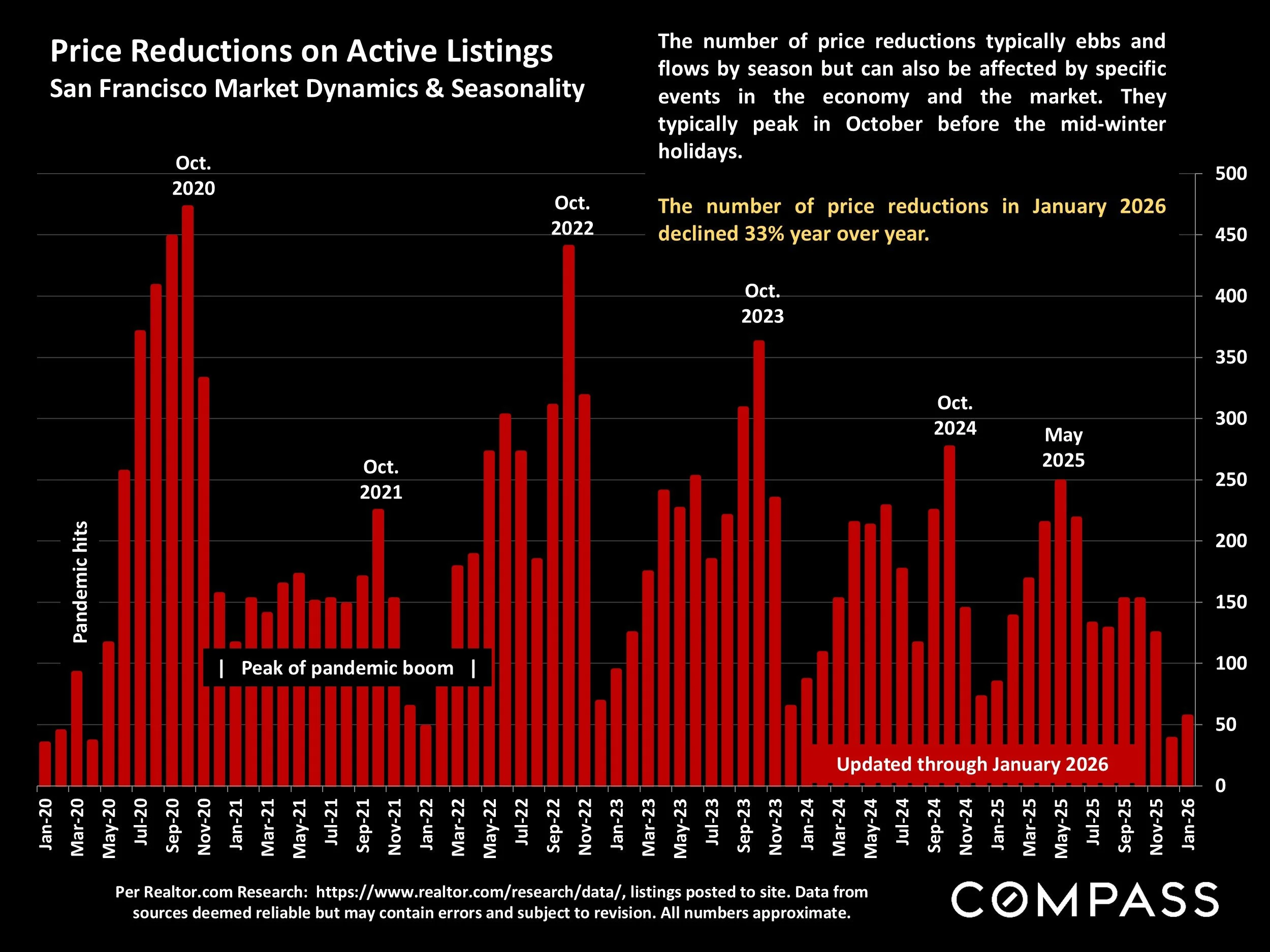
Per Realtor.com Research: https://www.realtor.com/research/data/, listings posted to site. Data from sources deemed reliable but may contain errors and subject to revision. All numbers approximate.
The number of price reductions in January 2026 declined 33% year over year.
The number of price reductions typically ebbs and flows by season but can also be affected by specific events in the economy and the market. They typically peak in October before the mid-winter holidays.
Overbidding List Prices in San Francisco
Percentage of Home Sales Closing over List Price
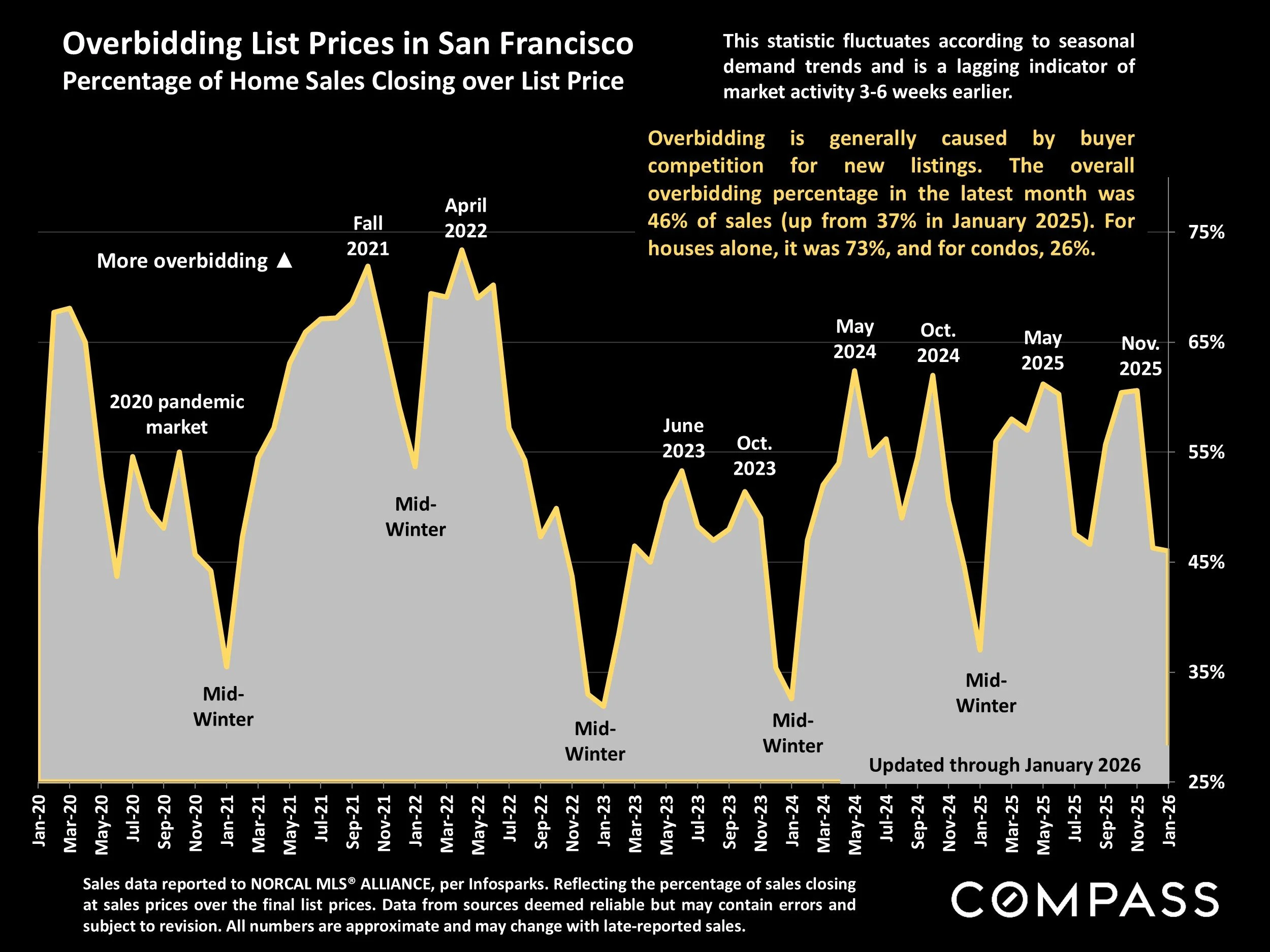
Sales data reported to NORCAL MLS® ALLIANCE, per Infosparks. Reflecting the percentage of sales closing at sales prices over the final list prices. Data from sources deemed reliable but may contain errors and subject to revision. All numbers are approximate and may change with late-reported sales.
Overbidding is generally caused by buyer competition for new listings. The overall overbidding percentage in the latest month was 46% of sales (up from 37% in January 2025). For houses alone, it was 73%, and for condos, 26%.
This statistic fluctuates according to seasonal demand trends and is a lagging indicator of market activity 3-6 weeks earlier.
Average Sales Price to Original List Price Percentage
San Francisco Over/Under Bidding: Market Dynamics & Seasonality

Sales reported to NorCal MLS Alliance, per Infosparks. Data derived from sources deemed reliable but may contain errors and subject to revision. All numbers approximate and may change with late-reported sales.
This chart illustrates the average Sales Price to Original List Price Percentage for all residential sales, but in January 2026, for houses alone the average was 15% above list price, and for condos, 2% under list price.
This statistic can be distorted by strategic underpricing strategies by listing agents.
Average Days on Market – Speed of Sale
San Francisco Market Dynamics & Seasonality
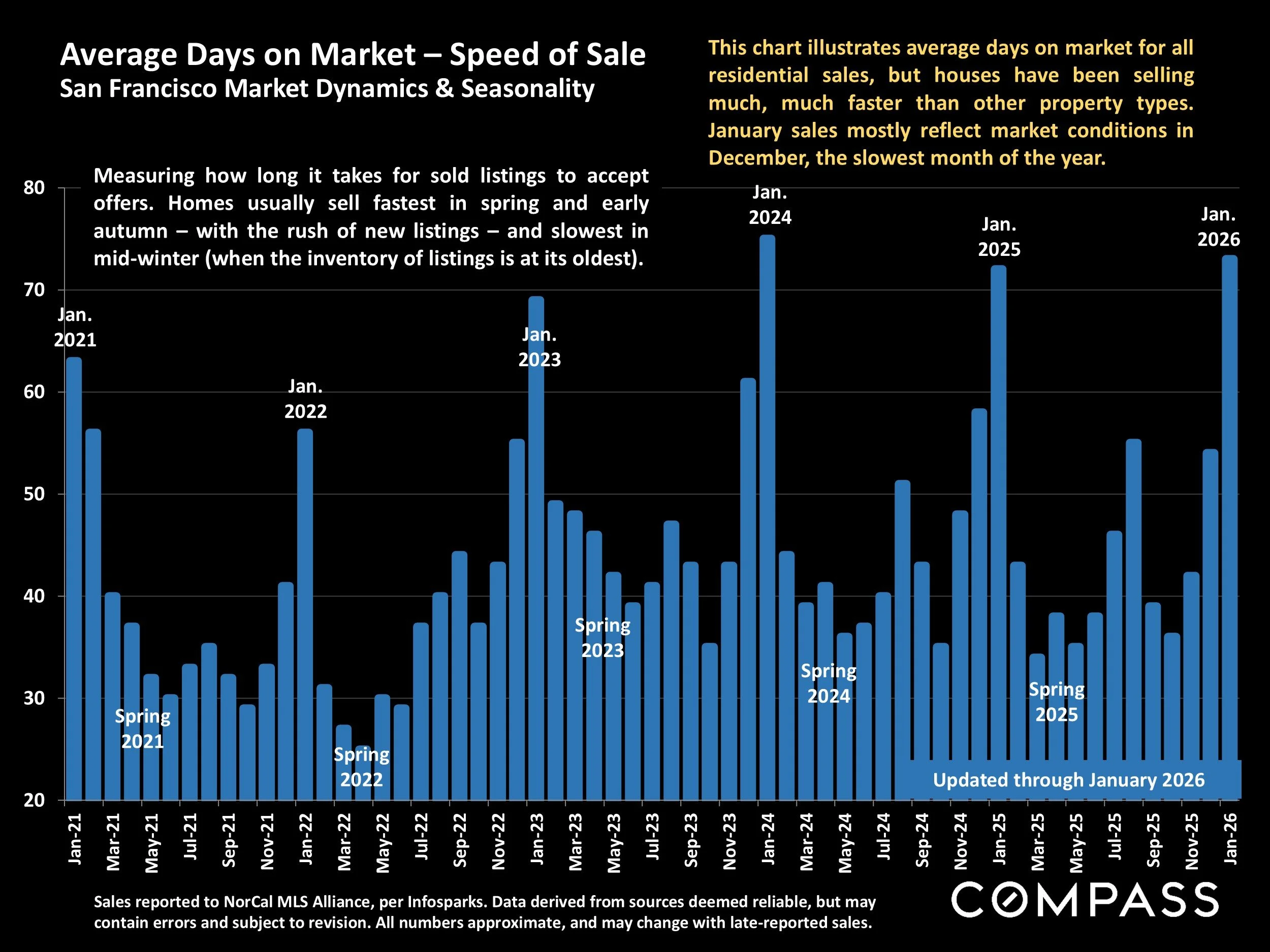
Sales reported to NorCal MLS Alliance, per Infosparks. Data derived from sources deemed reliable, but may contain errors and subject to revision. All numbers approximate, and may change with late-reported sales.
This chart illustrates average days on market for all residential sales, but houses have been selling much, much faster than other property types. January sales mostly reflect market conditions in December, the slowest month of the year.
Measuring how long it takes for sold listings to accept offers. Homes usually sell fastest in spring and early autumn – with the rush of new listings – and slowest in mid-winter (when the inventory of listings is at its oldest).
Selected Economic & Demographic Data
Federal Funds Interest Rate since 1981
& Economic Interventions by Federal Reserve Bank*
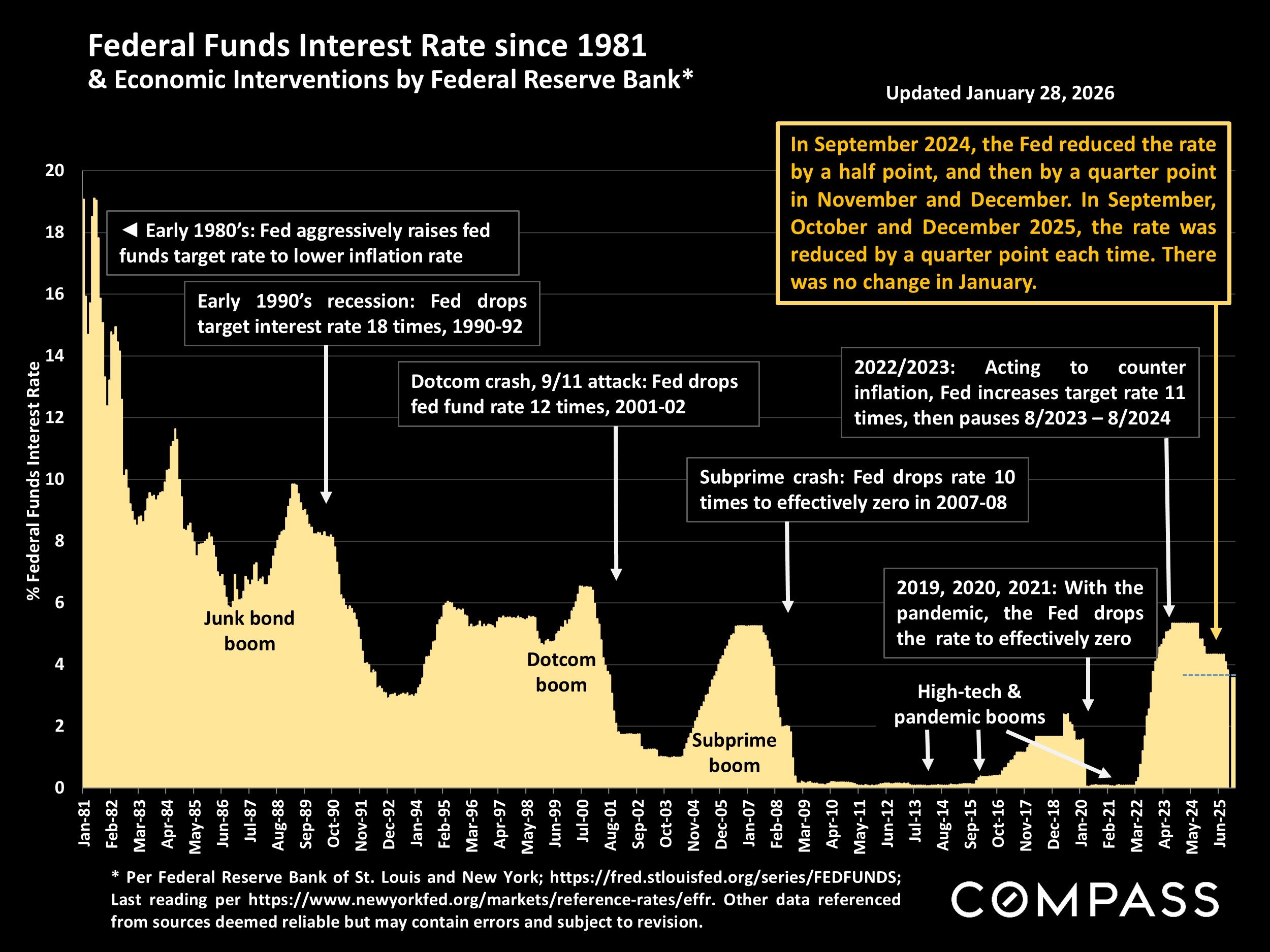
* Per Federal Reserve Bank of St. Louis and New York; https://fred.stlouisfed.org/series/FEDFUNDS; Last reading per https://www.newyorkfed.org/markets/reference-rates/effr. Other data referenced from sources deemed reliable but may contain errors and subject to revision.
In September 2024, the Fed reduced the rate by a half point, and then by a quarter point in November and December. In September, October and December 2025, the rate was reduced by a quarter point each time. There was no change in January.
Economic Policy Uncertainty Index*
By Month since January 2000
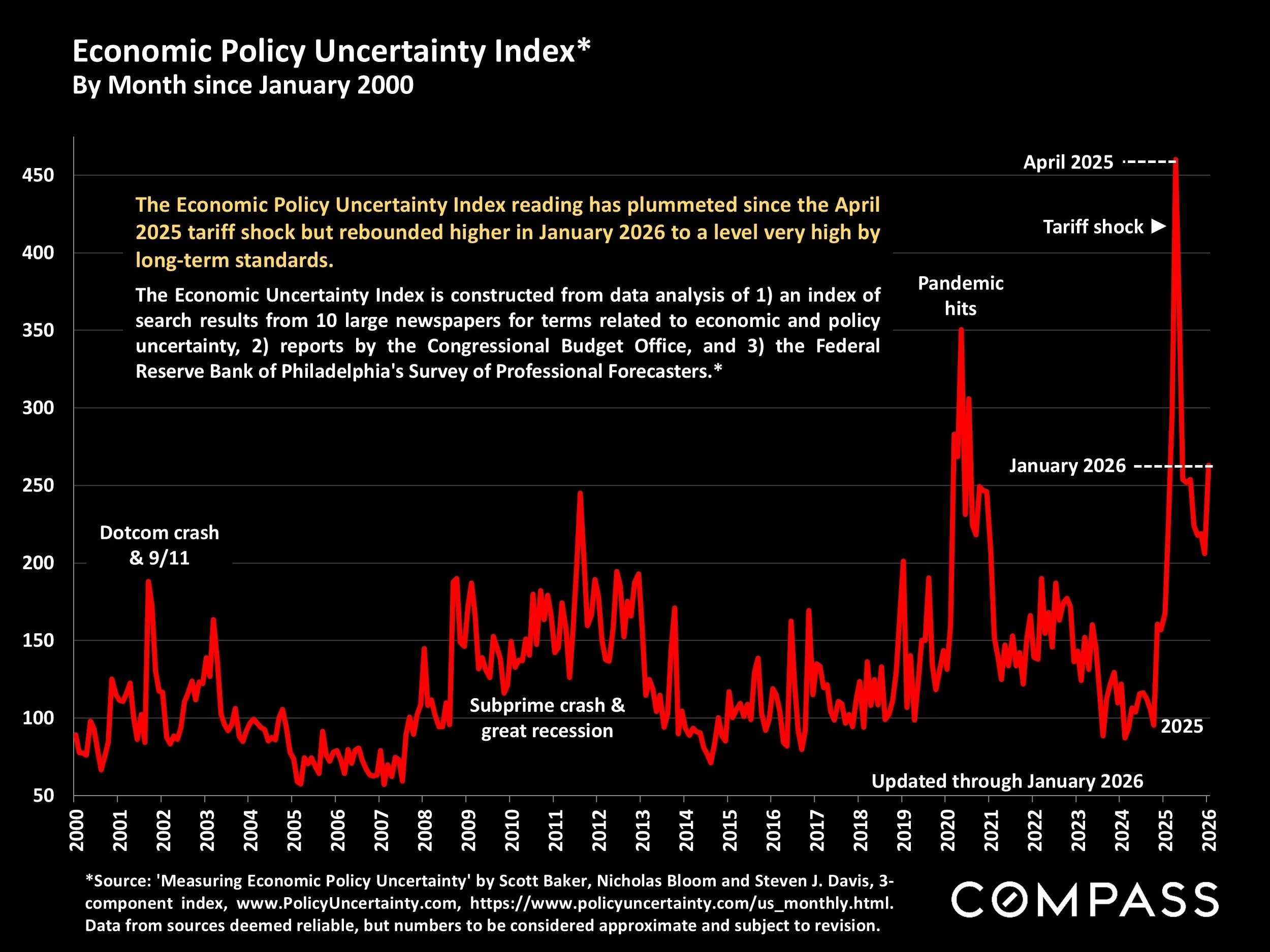
*Source: 'Measuring Economic Policy Uncertainty' by Scott Baker, Nicholas Bloom and Steven J. Davis, 3-component index, www.PolicyUncertainty.com, https://www.policyuncertainty.com/us_monthly.html. Data from sources deemed reliable, but numbers to be considered approximate and subject to revision.
The Economic Policy Uncertainty Index reading has plummeted since the April 2025 tariff shock but rebounded higher in January 2026 to a level very high by long-term standards.
The Economic Uncertainty Index is constructed from data analysis of 1) an index of search results from 10 large newspapers for terms related to economic and policy uncertainty, 2) reports by the Congressional Budget Office, and 3) the Federal Reserve Bank of Philadelphia's Survey of Professional Forecasters.*
California Population Trends since 2010
U.S. Census Estimates, July 1st to July 1st
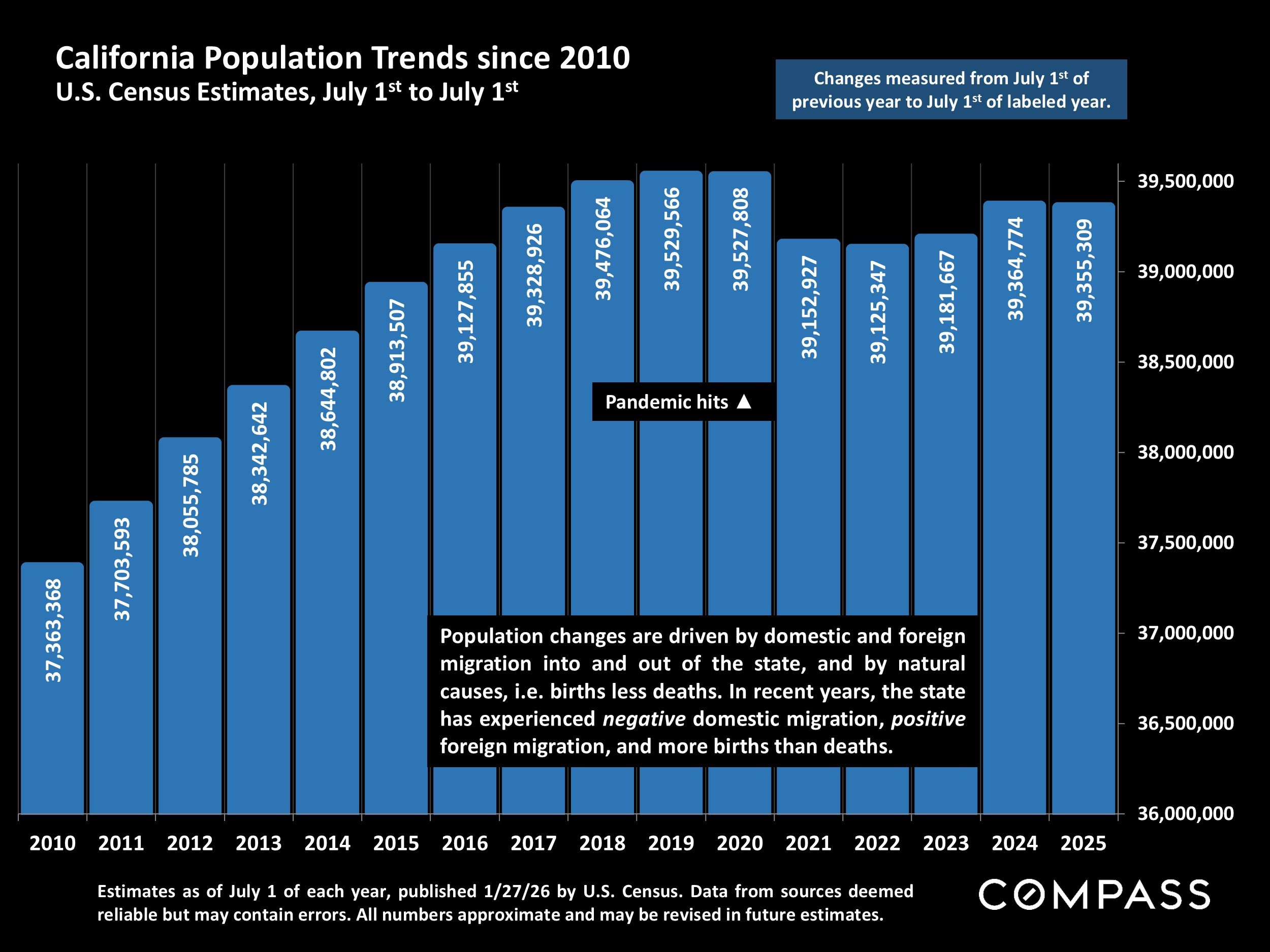
Estimates as of July 1 of each year, published 1/27/26 by U.S. Census. Data from sources deemed reliable but may contain errors. All numbers approximate and may be revised in future estimates.
Population changes are driven by domestic and foreign migration into and out of the state, and by natural causes, i.e. births less deaths. In recent years, the state has experienced negative domestic migration, positive foreign migration, and more births than deaths.
California: Components of Population Change*
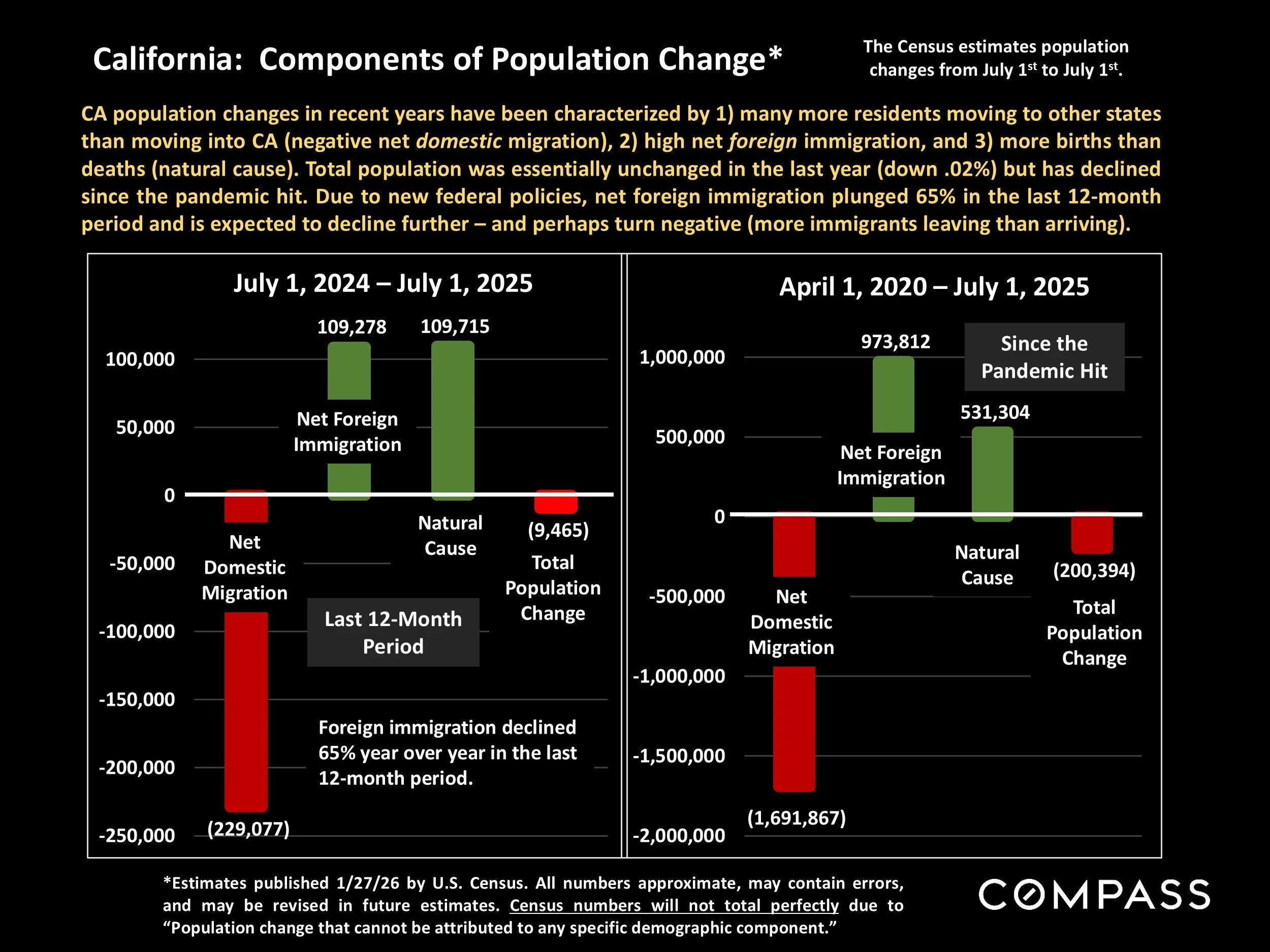
*Estimates published 1/27/26 by U.S. Census. All numbers approximate, may contain errors, and may be revised in future estimates. Census numbers will not total perfectly due to “Population change that cannot be attributed to any specific demographic component.”
CA population changes in recent years have been characterized by 1) many more residents moving to other states than moving into CA (negative net domestic migration), 2) high net foreign immigration, and 3) more births than deaths (natural cause). Total population was essentially unchanged in the last year (down .02%) but has declined since the pandemic hit. Due to new federal policies, net foreign immigration plunged 65% in the last 12-month period and is expected to decline further – and perhaps turn negative (more immigrants leaving than arriving).
California 2024 Migration Trends*
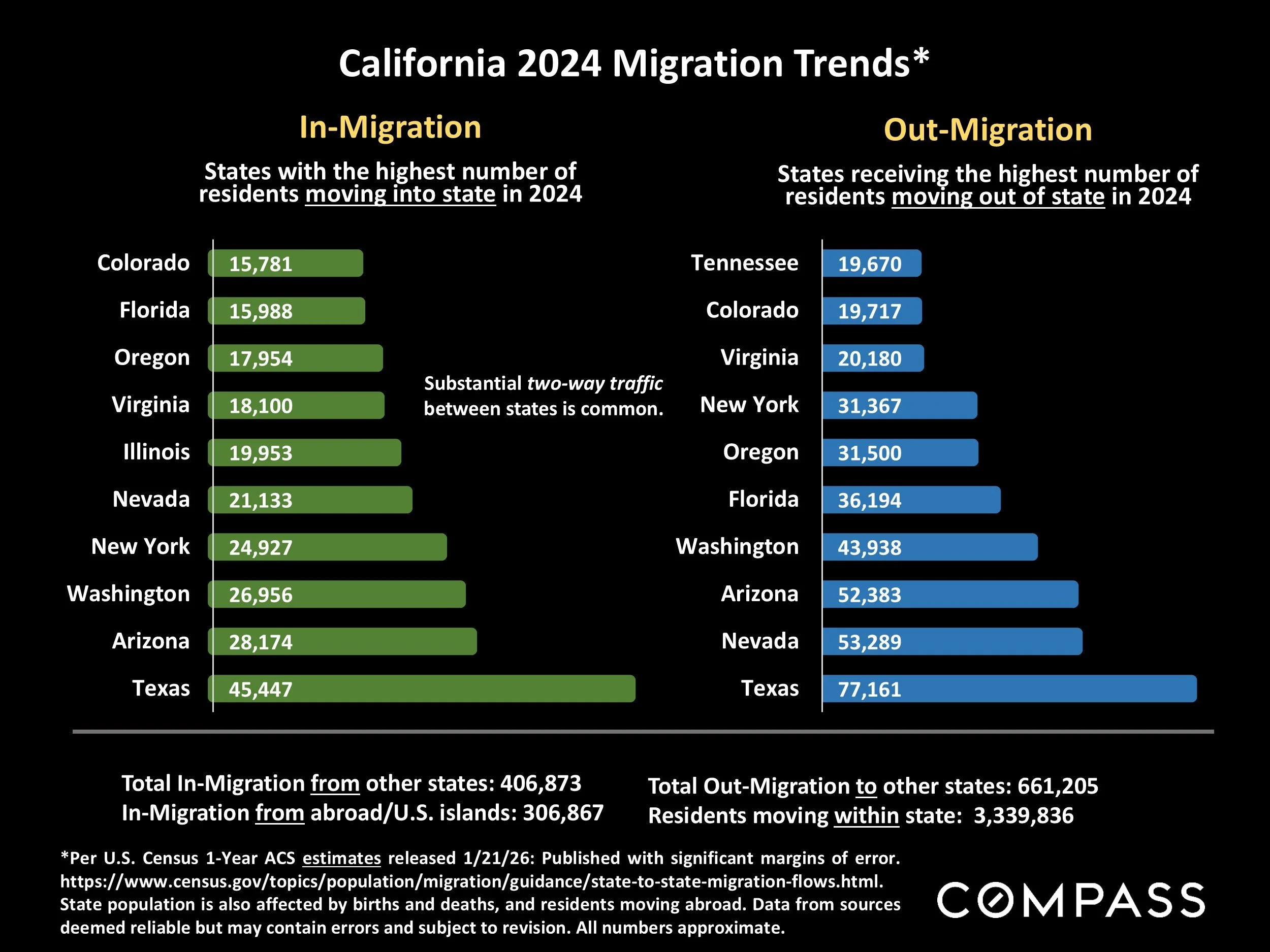
*Per U.S. Census 1-Year ACS estimates released 1/21/26: Published with significant margins of error. https://www.census.gov/topics/population/migration/guidance/state-to-state-migration-flows.html. State population is also affected by births and deaths, and residents moving abroad. Data from sources deemed reliable but may contain errors and subject to revision. All numbers approximate.
Total In-Migration from other states: 406,873
Total Out-Migration to other states: 661,205
Residents moving within state: 3,339,836
In-Migration from abroad/U.S. islands: 306,867
San Francisco Bay Area Unemployment Rates
Selected Bay Area Counties, since 2019
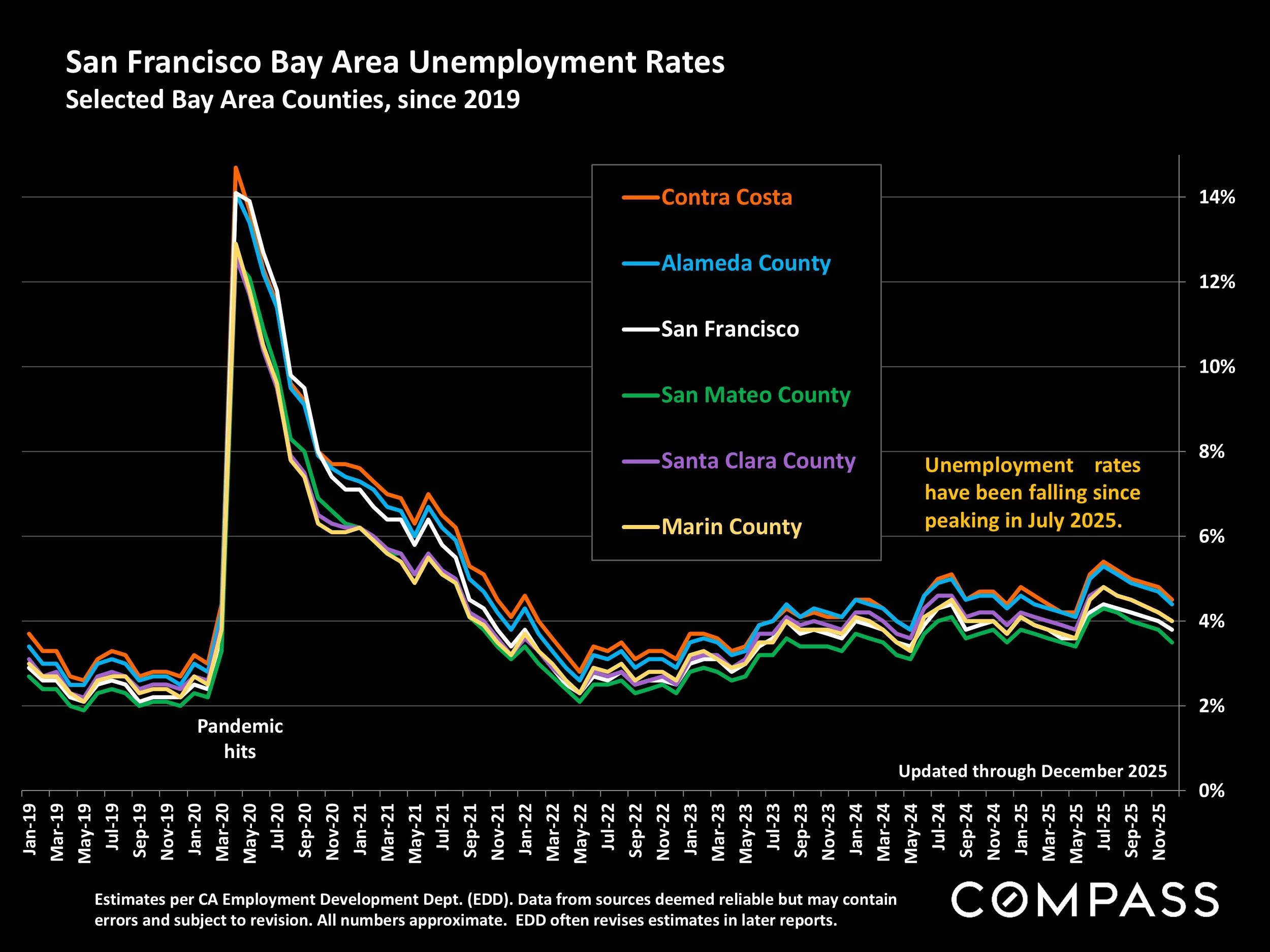
Estimates per CA Employment Development Dept. (EDD). Data from sources deemed reliable but may contain errors and subject to revision. All numbers approximate. EDD often revises estimates in later reports.
Unemployment rates have been falling since peaking in July 2025.
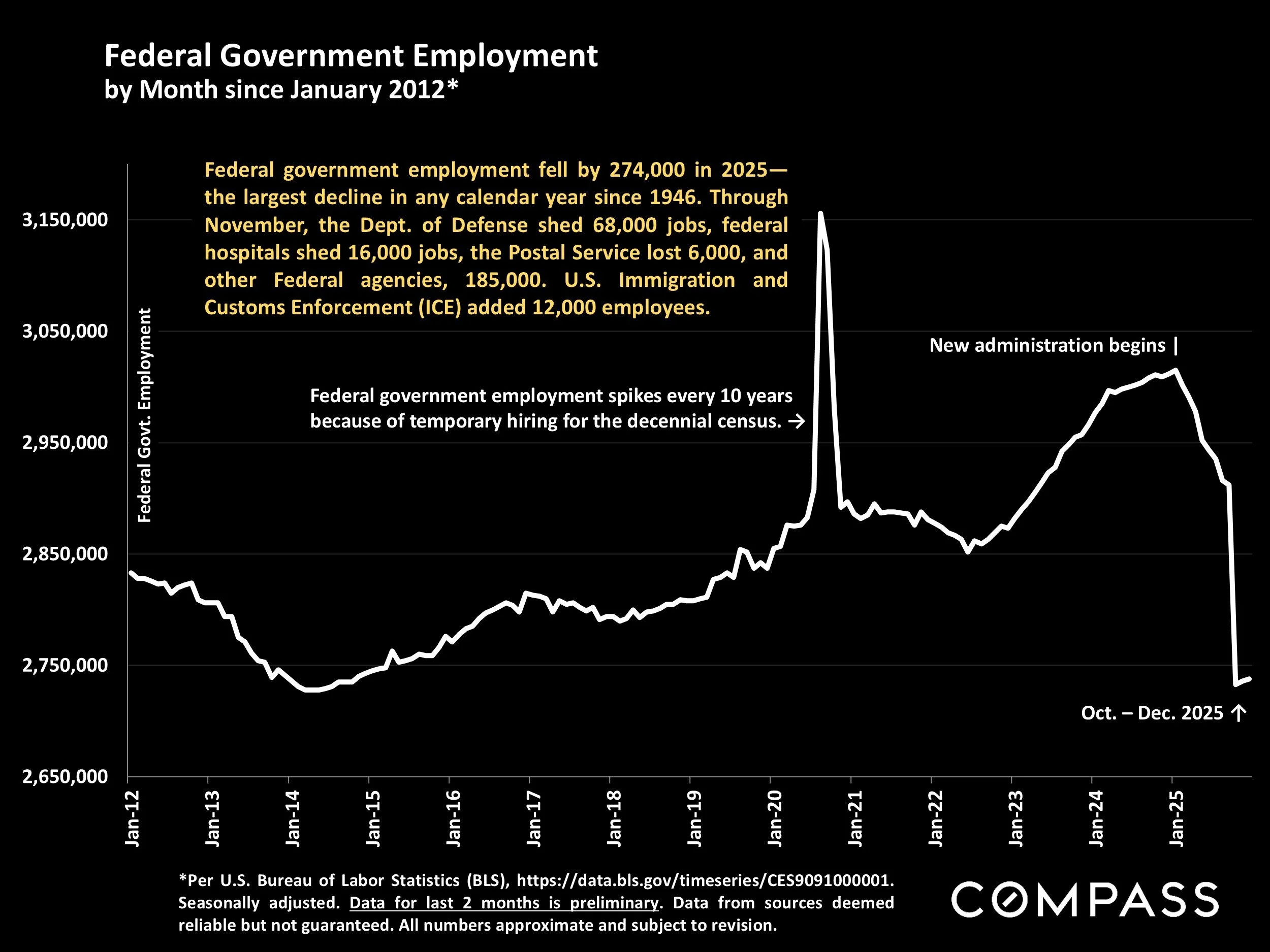
Federal Government Employment
by Month since January 2012*
*Per U.S. Bureau of Labor Statistics (BLS), https://data.bls.gov/timeseries/CES9091000001. Seasonally adjusted. Data for last 2 months is preliminary. Data from sources deemed reliable but not guaranteed. All numbers approximate and subject to revision.
Federal government employment fell by 274,000 in 2025—the largest decline in any calendar year since 1946. Through November, the Dept. of Defense shed 68,000 jobs, federal hospitals shed 16,000 jobs, the Postal Service lost 6,000, and other Federal agencies, 185,000. U.S. Immigration and Customs Enforcement (ICE) added 12,000 employees.
Federal government employment spikes every 10 years because of temporary hiring for the decennial census. →
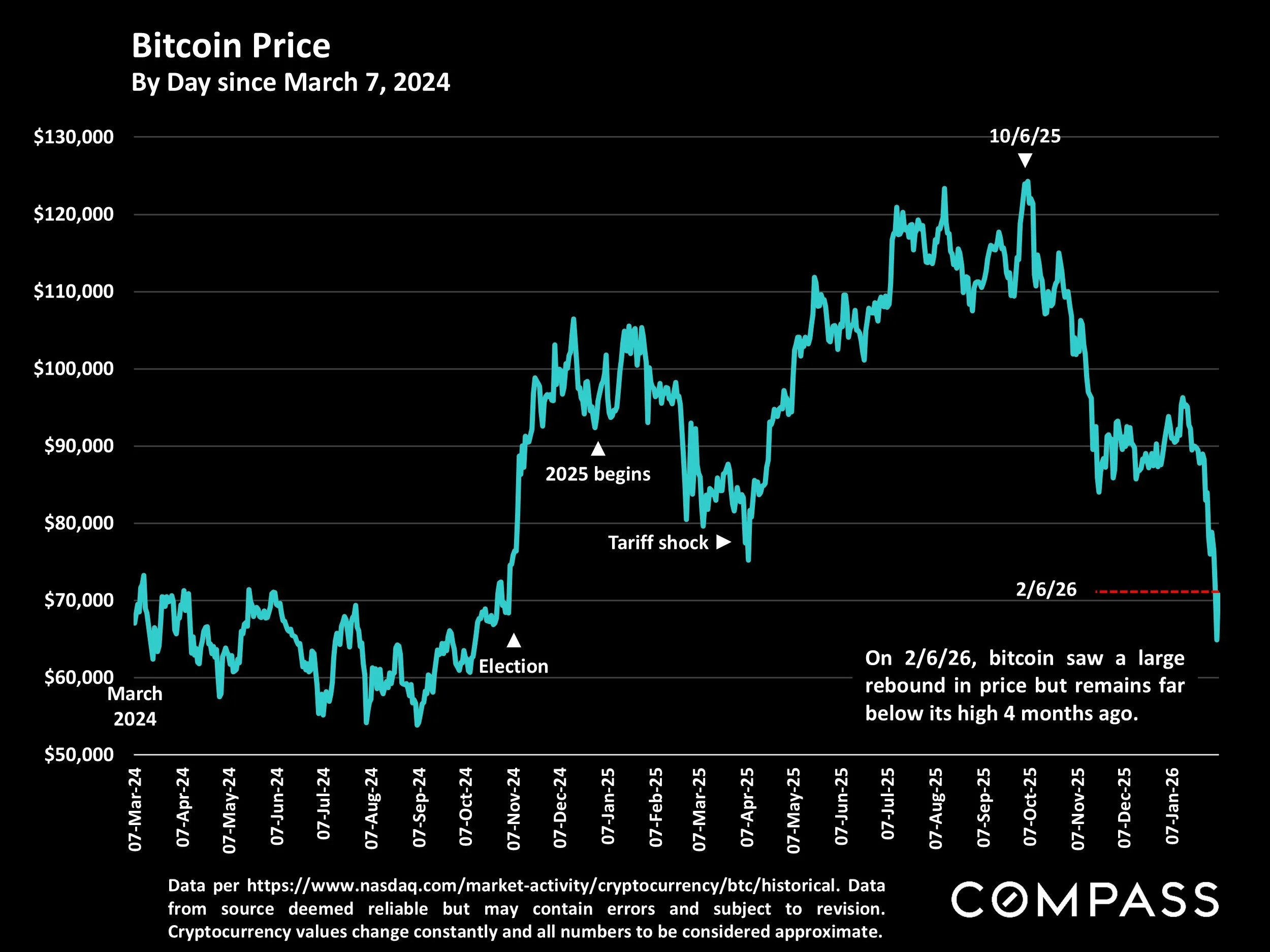
Bitcoin Price
By Day since March 7, 2024
Data per https://www.nasdaq.com/market-activity/cryptocurrency/btc/historical. Data from source deemed reliable but may contain errors and subject to revision. Cryptocurrency values change constantly and all numbers to be considered approximate.
On 2/6/26, bitcoin saw a large rebound in price but remains far below its high 4 months ago.
Statistics are generalities, essentially summaries of widely disparate data generated by dozens, hundreds or thousands of unique, individual sales occurring within different time periods. They are best seen not as precise measurements, but as broad, comparative indicators, with reasonable margins of error. Anomalous fluctuations in statistics are not uncommon, especially in smaller, expensive market segments. Last period data should be considered estimates that may change with late-reported data. Different analytics programs sometimes define statistics – such as “active listings,” “days on market,” and “months supply of inventory” – differently: what is most meaningful are not specific calculations but the trends they illustrate. Most listing and sales data derives from the local or regional multi-listing service (MLS) of the area specified in the analysis, but not all listings or sales are reported to MLS and these won’t be reflected in the data. “Homes” signifies real-property, single-household housing units: houses, condos, co-ops, townhouses, duets and TICs (but not mobile homes), as applicable to each market. City/town names refer specifically to the named cities and towns, unless otherwise delineated. Multi-county metro areas will be specified as such. Data from sources deemed reliable, but may contain errors and subject to revision. All numbers to be considered approximate.
Many aspects of value cannot be adequately reflected in median and average statistics: curb appeal, age, condition, amenities, views, lot size, quality of outdoor space, “bonus” rooms, additional parking, quality of location within the neighborhood, and so on. How any of these statistics apply to any particular home is unknown without a specific comparative market analysis.
Median Sales Price is that price at which half the properties sold for more and half for less. It may be affected by seasonality, “unusual” events, or changes in inventory and buying trends, as well as by changes in fair market value. The median sales price for an area will often conceal an enormous variety of sales prices in the underlying individual sales.
Dollar per Square Foot is based upon the home’s interior living space and does not include garages, unfinished attics and basements, rooms built without permit, patios, decks or yards (though all those can add value to a home). These figures are usually derived from appraisals or tax records, but are sometimes unreliable (especially for older homes) or unreported altogether. The calculation can only be made on those home sales that reported square footage.
Compass is a real estate broker licensed by the State of California, DRE 01527235. Equal Housing Opportunity. This report has been prepared solely for information purposes. The information herein is based on or derived from information generally available to the public and/or from sources believed to be reliable. No representation or warranty can be given with respect to the accuracy or completeness of the information. Compass disclaims any and all liability relating to this report, including without limitation any express or implied representations or warranties for statements contained in, and omissions from, the report. Nothing contained herein is intended to be or should be read as any regulatory, legal, tax, accounting or other advice and Compass does not provide such advice. All opinions are subject to change without notice. Compass makes no representation regarding the accuracy of any statements regarding any references to the laws, statutes or regulations of any state are those of the author(s). Past performance is no guarantee of future results.